
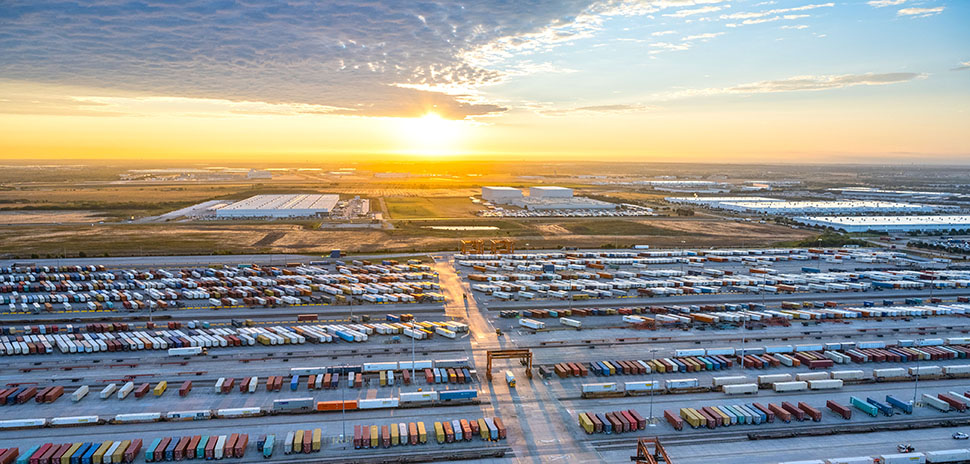
 The future of logistics isn’t being built in Silicon Valley. It’s being built in Fort Worth.
Hillwood’s decades-long commitment to AllianceTexas—anchored by public-private partnerships, infrastructure investment, and a clear-eyed view of what next-generation supply chains would require—created the foundation for what’s happening today. Over time, advancements in autonomous technology, regulatory frameworks, and industry needs aligned with Hillwood’s existing infrastructure strategy. This convergence enabled the company to pair its vision with complementary investments from regional partners, creating a platform for additional improvements happening now and planned for the future.
That partnership extends across municipal and regional boundaries. The City of Fort Worth, TxDOT, the North Central Texas Council of Governments (NCTCOG), and the City of Haslet have coordinated to deliver a $262 million grant for a direct flyover connection from Interstate 35W into the AllianceTexas Smart Port via the SH-170 Spur connector. This critical infrastructure optimizes freight movement to AllianceTexas facilities and BNSF’s intermodal terminal while reducing congestion on public roadways and lowering emissions—a regional mobility enhancement that unlocks the full potential of what comes next.
The Infrastructure Behind the Innovation
In November 2025, the City of Fort Worth, Hillwood, and BNSF Railway established the Alliance Logistics District — a 1,400-acre zone that represents the first freight corridor of its kind within BNSF’s rail and intermodal network. Built on the foundation of what the SH-170 Spur connector will enable, the district grants unprecedented operational flexibility: the right to deploy semi- and fully autonomous vehicles along district roadways, the use of private hostler vehicles without commercial driver’s license requirements, and heavy-haul freight movements exceeding 80,000 pounds without special permits.
It’s a regulatory breakthrough that could save customers millions annually while reducing congestion on public roads. More significantly, it positions AllianceTexas as the proving ground for technologies that will define the next era of supply chain efficiency.
“This is a first-of-its-kind district that enables advanced logistics operations, including autonomous and heavy-haul freight movement,” says Nicholas Konen, vice president of strategic development at Hillwood. “We’re trying to make that movement as efficient as possible, and to allow for any type of movement that could theoretically come off of the rail.”
Complementing the $262 million public grant is Hillwood’s $20 million private three-lane bridge currently under construction over FM 156, designed exclusively for commercial and autonomous semitrucks shuttling cargo between BNSF’s Alliance Intermodal Facility and the district’s 15 million square feet of distribution, logistics, and manufacturing space. The bridge — closed to residential traffic and equipped with automated gates — will directly link the container depot to the intermodal terminal, dramatically reducing transit time and eliminating the need for freight to navigate public roads. Construction is expected to wrap in late 2027.
The Smart Port strategy integrates multiple layers of infrastructure: an Integrated Intermodal Network leveraging BNSF’s 500-acre Alliance facility processing over 1 million lifts annually, enhanced connectivity via 5G communication network capacity and a centralized container-tracking database, a new 32-acre integrated intermodal depot, Resilient Microgrid Power ensuring operational continuity, and a direct connection to the Texas Connected Freight Corridor. All working together to enable efficient movement of goods while maintaining resilience and connectivity at every layer.
Logistics and Manufacturing at Scale
While the infrastructure is critical, it’s the integration of logistics operations, third-party logistics providers, and the advanced manufacturing customer base that makes AllianceTexas a genuine inflection point for the supply chain industry. The Alliance Logistics District’s operational flexibility creates a controlled environment where logistics companies can operate with unprecedented efficiency. By eliminating the variability of traditional public roadways, the district provides a testbed where advanced freight systems can operate at higher efficiency with lower risk.
“This controlled setting allows for safer integration of advanced vehicle technologies while maintaining oversight and adaptability as conditions change,” Konen says.
The vehicles operating within the district are purpose-built for predictable freight movements, such as short-haul shuttles between facilities and the intermodal terminal, rather than long-distance highway runs. These operations are being conducted by logistics providers and manufacturing tenants who rely on seamless connections between rail and their distribution facilities.
The Economic Proof Point
AllianceTexas has generated a cumulative economic impact of $142.9 billion since 1990, according to a February 2026 presentation to Fort Worth officials. Local communities have invested an estimated $4.55 billion in property taxes over that period.
But it’s the recent acceleration that tells the more compelling story. In 2024, AllianceTexas accounted for $834.6 million in international trade—a 550.7 percent increase from 2016, according to a study from the Texas Comptroller’s office. Exports at AllianceTexas increased 378 percent between 2023 and 2024 alone.
Acting Texas Comptroller Kelly Hancock emphasized the facility’s strategic importance during a stop on the Good for Texas Tour: Ports Edition. “Ports are key to Texas’ economic strength. They power trade, jobs and innovation,” Hancock said. “AllianceTexas is a clear example of how forward-thinking infrastructure keeps our economy strong and competitive worldwide.”
Of the $1.6 billion invested in AllianceTexas in 2025, federal and state funds accounted for 43.02 percent, reflecting the facility’s recognition as critical infrastructure for national supply chain resilience.
Why This Matters for North Texas
The logistics industry is undergoing a transformation as profound as the shift from steam to diesel or analog to digital. Autonomous vehicles, AI-driven route optimization, and intelligent infrastructure are converging to redefine how goods move through global supply chains — and AllianceTexas has positioned itself as the epicenter of that transformation.
What’s happening at AllianceTexas is more than incremental improvement. It’s a fundamental reimagining of what a port can be. A place where policy, infrastructure, and technology align to create competitive advantages that compound over time. The Alliance Logistics District isn’t just enabling efficient movement of goods; it’s reducing operational costs for co-located companies, pulling traffic off public roads, lowering carbon emissions, and creating a live testbed where the next generation of logistics technology can be developed, refined, and scaled.
A Proving Ground for the Future
AllianceTexas has become a testbed for innovations that extend well beyond freight.
Aviation startup Aerolane established its flight operations headquarters at Perot Field Alliance Airport and successfully completed flight testing of its Aerocart cargo glider system—a “sky train” technology designed to dramatically reduce fuel costs by towing unpowered cargo gliders behind traditional aircraft. The system is now cleared for commercial deployment. Additionally, the low-altitude weather data network deployed by TruWeather Solutions throughout AllianceTexas, backed by grants from NASA and the U.S. Department of Transportation, provides real-time micro-weather intelligence critical for drone delivery and electric vertical takeoff and landing aircraft operations as well as autonomous surface operators—creating the data infrastructure necessary for next-generation autonomous air systems to operate safely in variable conditions.
Autonomous Solutions Inc., a global leader in industrial vehicle automation, opened its newest U.S. office in AllianceTexas in 2025, citing the region’s momentum as a center for innovation. Even rare-earth magnet production is finding a home at AllianceTexas. MP Materials, which recently announced a multibillion-dollar Department of Defense partnership and a $500 million collaboration with Apple to produce 100 percent recycled rare-earth magnets, has operations in the development, cementing AllianceTexas’ role in securing domestic supply chains for critical materials.
The Bottom Line
What’s being built at AllianceTexas isn’t a logistics facility. It’s an operating system for the future of freight. A place where autonomous vehicles, intelligent infrastructure, and forward-thinking regulation converge to create a competitive advantage that scales.
For North Texas, that advantage compounds in two directions. First, AllianceTexas attracts the companies building next-generation supply chain technologies—the logistics innovators, the manufacturing leaders, the third-party logistics providers who need live testing environments to validate their systems. Second, it attracts manufacturers, distributors, and e-commerce giants who need access to the most efficient, cost-effective logistics infrastructure available.
The result is an innovation flywheel: better infrastructure attracts better companies, which attract more investment, which funds better infrastructure.
North Texas has always been a logistics hub. What’s happening at AllianceTexas is the evolution from hub to epicenter, a place where goods pass through to a place where the technologies defining the future of global trade are being invented, tested, and deployed at scale.
This autonomous logistics ecosystem isn’t a bet on the future. It’s the future arriving ahead of schedule, and AllianceTexas is writing the playbook.
Learn more about the AllianceTexas Mobility Innovation Zone at alliancetexasmiz.com

Don’t miss what’s next. Subscribe to Dallas Innovates.
Track Dallas-Fort Worth’s business and innovation landscape with our curated news in your inbox Tuesday-Thursday.
R E A D N E X T
-

You'll find deadlines coming up for a new accelerator program; and many more opportunities.
-

The Texas Innovation Operating System is tapping into what the partners call "a growing alignment across Texas for a broader innovation community." The connected system aims to be a first step in what the partners describe as "the G20 of Texas Cities in Innovation"—promoting regional innovation as well as connecting into the broader statewide network.
-

Texas Instruments invented the world's first handheld electronic calculator prototype in 1967. This week, it launched a new graphing calculator "built to meet the demands of today's math classroom" and to grow with students from middle school algebra all the way through college and future STEM careers.
-
![Jeb Hensarling [Photo: Grant Miller Photograhy/Venture Dallas]](https://s24806.pcdn.co/wp-content/uploads/2025/11/20251030VentureDallasConference-DSC_6240.jpg)
In a Bloomberg interview with Julie Fine, the former congressman laid out TXSE's timeline: trading this summer, listings in Q4, and first IPOs in Q1 2027.
-

“With more than 300 animal-focused organizations participating in this fundraising campaign, NorthTexasGivingDay.org makes it easy to support nonprofits you know and love while also discovering new ones making an impact on the lives of pets and their families,” said Communities Foundation of Texas President and CEO Wayne White.
-

Participants at the Pegasus Park event had 48 hours to turn early-stage concepts and functional prototypes into actionable solutions "to improve health outcomes, expand access, improve patient experience, and drive system-wide efficiency," Health Wildcatters said.
-
In a letter to GameStop CEO Ryan Cohen, the billionaire co-founder of Chewy, eBay Board Chairman Paul S. Pressler poured cold water on the Grapevine-based company's acquisition bid.
-
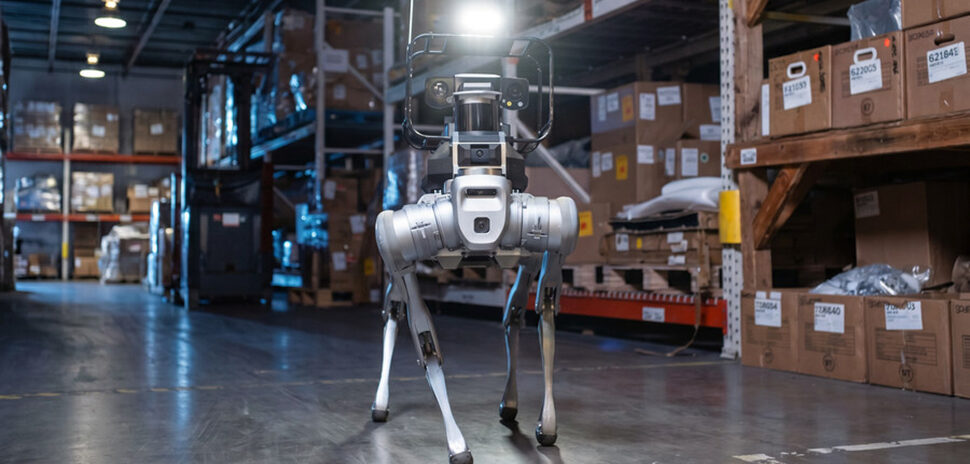
GoLabs said Unitree's autonomous quadrupeds use an integrated 4D LiDAR system and SLAM technology to create 3D maps of their security perimeter. Companies can then give the robots automated patrol paths and checkpoints, making a security system "both simple and efficient."
-

First launched in 2018, the invitation-only summit is returning as an "annual signature event" for strengthening U.S.-Japan economic ties, with Arlington serving as host city for three consecutive years. Topics include everything from biotech to next-gen mobility to sports & entertainment—and, of course, AI.
-
![An MK30 drone on a landing pad. Amazon began commercial drone service with the MK30 in College Station, Texas, and the Phoenix metro area in November 2024. [Photo: Amazon]](https://s24806.pcdn.co/wp-content/uploads/2026/04/Amazon-MK30-drone.jpg)
CRE platform BLDUP reported the $25 million West Dallas filing on April 17. Amazon CEO Andy Jassy calls Prime Air's drone delivery effort "a multi-year invention cycle," with test flights from the new paddock possible as early as August.