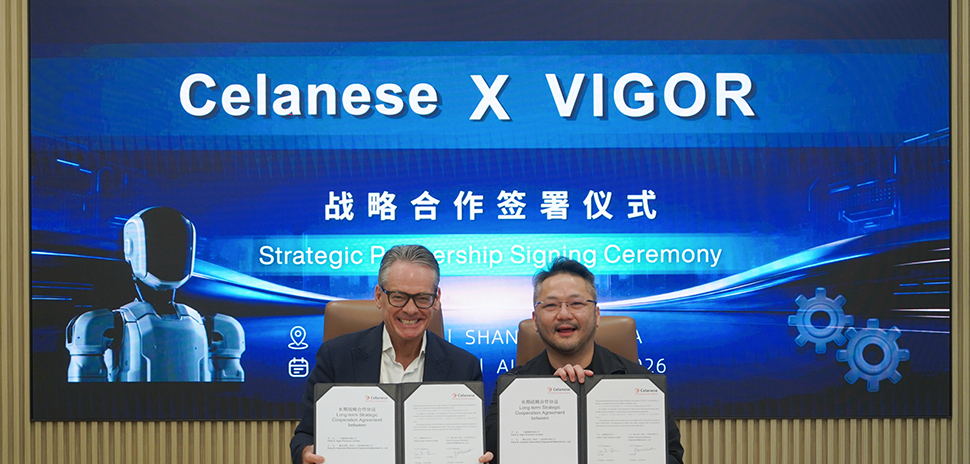
Irving-based Celanese Corp., a specialty materials and chemical company, has teamed up with Hong Kong-based VIGOR Precision Ltd., a manufacturer of plastic gears, to develop lightweight plastic joints for humanoid robots.
Amid the growth of AI as well as embodied intelligence — AI systems that interact directly with the physical world — more companies are rolling out human-like robots. However, the weight of traditional metal joints limits the endurance, response times and load-bearing capabilities of human-like robots, the companies said. Enter plastic joints.
“Robotics is an increasingly important growth area for engineered materials, with customers seeking compact, durable, lightweight and low-noise solutions that can perform reliably in demanding applications,” Todd Elliott, senior vice president of Celanese Engineered Materials, said in a statement. “Through this partnership, we can bring Celanese materials science, application development and local technical capabilities together with VIGOR’s precision gear design and manufacturing expertise to help enable the next generation of robotic motion systems.”
Celanese views robotic components as an emerging sector, company executives said.
Lightening the load and improving performance
Celanese and VIGOR signed a partnership deal at the Celanese Shanghai Commercial and Technology Center to develop and commercialize lightweight plastic joints for human-like robots. Executives from both companies attended the Aug. 14 deal-signing ceremony, including VIGOR CEO Hoi-sang Chan and Celanese’s Elliott.
Under the agreement, Celanese will provide high-performance plastics and technical support for robotics components.
The companies hope to decrease the weight of joint modules by more than 30% by replacing traditional metals with high-performance plastics while ensuring precision and long-term reliability.
Joints of human-like robots endure great demands during high-speed starts and stops, high-frequency motions and collisions between numerous forces and components or materials. The partners said they aim to overcome technical challenges, such as those associated with high strength and high rigidity, exceptional temperature resistance and thermal stability, precision transmission and self-lubricating properties.
The agreement establishes a supplier-customer relationship and offers “deep technical integration,” the companies said.
Celanese builds on ties to Asia
This is not Celanese’s first partnership with an Asian company. In 2025, Celanese forged a partnership with Li Auto for a low-emissions vehicle cabin that reduces “the new car smell” produced by formaldehyde.
Founded in Switzerland more than 100 years ago, Celanese employs more than 11,000 people in North Texas, Switzerland, China and two dozen other countries. One of the world’s largest producers of acetyl products for chemical compounds, Celanese also makes paints, polymers and other products for more than a dozen industries, ranging from aerospace and agriculture to energy and telecom.
Celanese, a Fortune 500 company, recorded net sales of $9.5 billion in 2025.
Since 1982, VIGOR has made high-precision plastic gears and components. Now, through the strategic partnership with Celanese, VIGOR is focusing on research and development of next-generation plastic joints for human-like robots.
“VIGOR possesses deep technical expertise in precision plastic molding, while Celanese is a global leader in high-performance materials science,” Chan said. “[This] partnership marks a crucial step in infusing ‘material genetics’ into ‘precision manufacturing.’ We look forward to working closely together to achieve the precise formulation of high-performance materials for robotic joints, thereby clearing the way for the large-scale deployment of humanoid robots.”
Don’t miss what’s next. Subscribe to Dallas Innovates.
Track Dallas-Fort Worth’s business and innovation landscape with our curated news in your inbox Tuesday-Thursday.