As economic opportunities increase in space and the lunar surface, Dallas-based Solidion Technology has announced a patented new solution to power what’s coming: extreme-climate battery technology. The company’s Generation Extreme-Climate Battery (Gen-ECB) platform is built to provide reliable, high-performance power storage for satellites, low Earth orbit-based AI data centers, crewed spacecraft, and future infrastructure on the moon.
The launch aims to support the rapid expansion of commercial space activity led by SpaceX’s upcoming IPO and NASA’s Artemis lunar program, Solidion said.
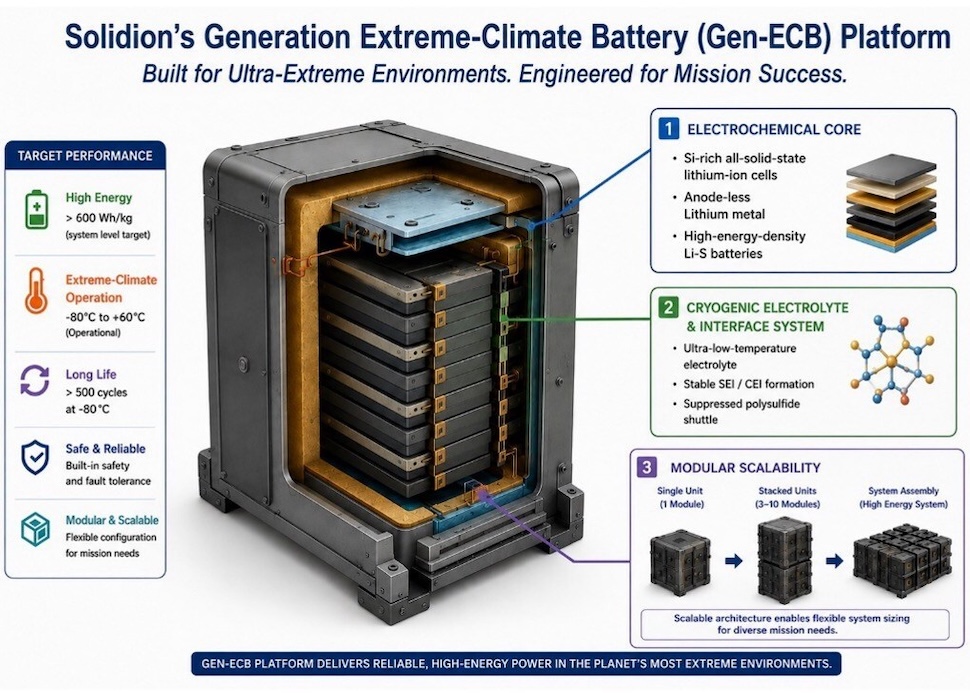
Solidion’s Gen-ECB platform delivers reliable, high-energy power in the planet’s most extreme environments, the company said. [Image: Solidion Technology]
Solidion’s Gen-ECB utilizes the exceptional thermal conductivity and radiation resistance of graphene to continuously regulate temperature within battery cells. It can rapidly dissipate heat to prevent thermal runaway and, in extreme cold, can pull warmth from external sources such as solar panels to maintain stable operations. The result is a battery system capable of operating reliably from −80°C to +60°C—with ongoing development aiming for even broader temperature ranges for deep-space missions, the company said.
Solidion’s CEO, Jaymes Winters. said that powering missions in the vacuum of space “requires technology that can perform amid intense solar radiation, extreme temperature fluctuations, and the severe vibrations of a launch payload.”
“Solidion’s Gen-ECB and advanced battery platforms deliver exactly that—stable, reliable energy storage engineered for the harshest environments humanity has ever operated in,” Winters added in a statement. “We’re actively engaging with aerospace partners to integrate Solidion’s technology into next-generation vehicles and infrastructure, positioning our shareholders at the forefront of the multi-planetary future.”
Key uses for new battery platform
Per Solidion, the Gen-ECB can support numerous space initiatives, including:
Satellite & LEO AI Data Centers: The Gen-ECB can extend mission life, increase operational uptime, improve satellite endurance, and provide high-reliability energy storage throughout the full thermal spectrum of orbital operations, supporting one of the fastest-growing segments of the space economy.
SpaceX Synergies: As Starship conducts routine cargo and crew missions to the Moon and Mars, Solidion’s batteries offer compact, reliable power for surface operations, energy storage during solar eclipses, and auxiliary systems — far surpassing traditional space batteries in performance and safety.
NASA Artemis & Lunar Infrastructure: Future Artemis and deep-space exploration missions require rechargeable energy storage capable of surviving prolonged lunar thermal cycles. Gen-ECB is engineered to offer customized energy, lightweight operation, and long-duration reliability for lunar rovers, habitats, and surface power grids—with tested performance exceeding 500 charge cycles at −40°C, a critical durability benchmark for missions that cannot afford a power failure.
Robust supply chain and portfolio
With over 385 patents, U.S.-based green graphite production scaling, and silicon-anode leadership, Solidion said it supports American space leadership by reducing reliance on foreign battery materials—a critical consideration for the national security of U.S. space programs.
In addition to the Gen-ECB, Solidion said its portfolio of advanced batteries includes silicon-rich all-solid-state lithium-ion cells, anode-less lithium metal, and high-energy-density lithium-sulfur batteries with 380+ Wh/kg. That delivers dramatically higher energy-to-weight ratios with non-flammable solid electrolytes that are essential for crewed missions where power per pound matters, the company said.
Beyond space, Solidion’s batteries power electric vehicles, AI data center UPS systems, and aerospace applications, which create diversified revenue streams as the broader space economy and clean energy transition continue to accelerate.
Snagging three federal grants in the last year
In the last year, Solidion has landed three federal grants—from the U.S. Army’s STTR Program, ARPA-E (Advanced Research Projects Agency), and Department of Energy—to help it develop several novel advanced battery technologies.
Headquartered in Dallas with pilot production facilities in Dayton, Ohio, Solidion manufactures next-generation battery materials and components, and develops high-performance batteries for energy storage, including UPS systems serving the AI data center market, electric vehicles, and aerospace applications. The company’s 385+ patents cover such innovations as high-capacity, silane gas-free and graphene-enabled silicon anodes, biomass-based graphite, and advanced lithium-sulfur and lithium-metal technologies.
Solidion began trading on the Nasdaq in February 2024, and has also explored how the anode materials silicon oxide and silicon might improve the energy density of electric vehicle batteries, potentially extending EV range by 20% to 40%.
Don’t miss what’s next. Subscribe to Dallas Innovates.
Track Dallas-Fort Worth’s business and innovation landscape with our curated news in your inbox Tuesday-Thursday.
R E A D N E X T
-

North Texas has plenty to see, hear, and watch. Here are our editors' picks. Plus, you'll find more selections to "save the date."
-

Dallas' third poet laureate Kristoddie Woods steps in alongside youth poet laureate Cadence Diggs, a 17-year-old Booker T. Washington High School student, for a two-year term.
-

The new office is designed to simplify how organizations work with SMU—whether through research partnerships, workforce development, or student engagement.
-

"The old human-in-the-loop rules really don't work as well when you're looking at ubiquitous, automated AI agents that are acting 24/7 as digital workers." Danny Tobey, M.D., J.D. Chair, AI and Data Analytics DLA Piper ...speaking at Convergence AI Dallas on March 31 We're moving "from an era of chatbot AI, where there is always a human at the receiving end of recommendations, to agentic and physical AI," a world, Danny Tobey said, where AI "takes actions and makes decisions on behalf of humans" and "does so in ways that don't always stop for human intervention, permission and understanding." Companies…
-
According to a Business Insider report, Oracle will be the tenant for all three data centers, as well as the fourth one planned at the campus in Red Oak. Tokyo-based MUFG Bank, Ltd. was the administrative agent, coordinating lead arranger, and sole bookrunner on the $2 billion loan.
-

Parkland Center for Clinical Innovation CEO Steve Miff shares approach to transparency in its prediction models.
-
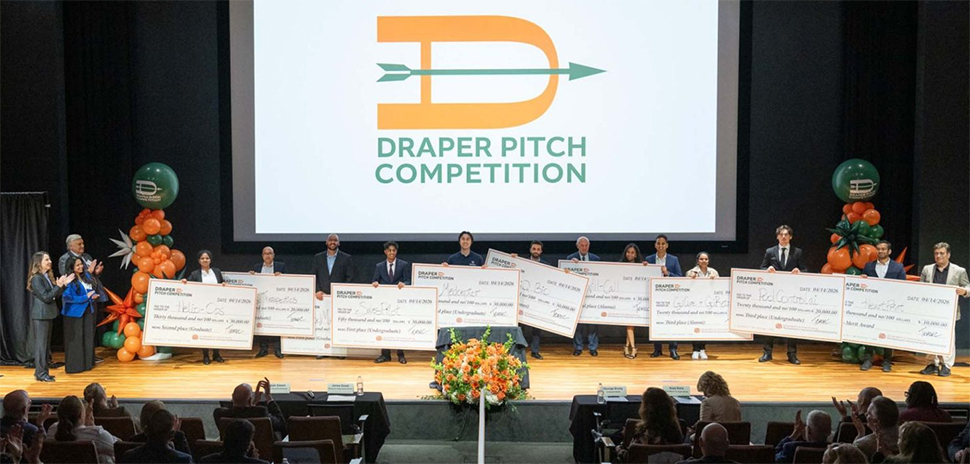
Nine student and alumni teams made the finals in three tracks: undergraduate, graduate student, and alumni. Winning ideas ranged from AI sales coaching to radiation mapping and noninvasive brain drug delivery as the university’s entrepreneurship push continues to scale.
-
Cuban didn’t hold back at Convergence AI Dallas, where his onstage conversation with Alex Kantrowitz delivered blunt advice and unfiltered insights.
-
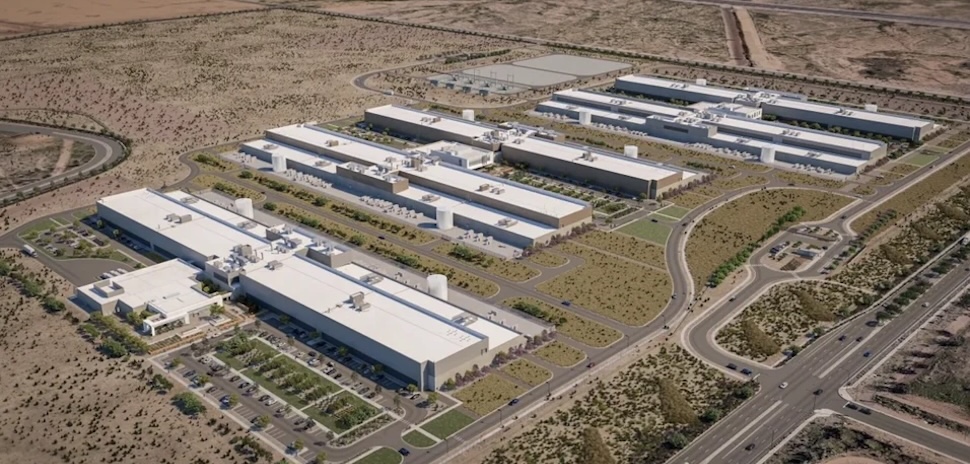 Dallas-Based CBRE Partners With Meta on Training Fiber Technicians to Build Meta’s U.S. Data Centers
CBRE said it plans to train "thousands of workers" to install technical infrastructure, fiber-optic cables, network gear, and other mission-critical equipment at Meta’s data center construction sites across the U.S.
-
With more than 50 years of combined experience, CFO Murray Woolcock and Construction EVP Scott Greubel will support Stream’s growth to meet hyperscale customer needs with reliable, strategic, and scalable deal structures and construction strategies, the company said.