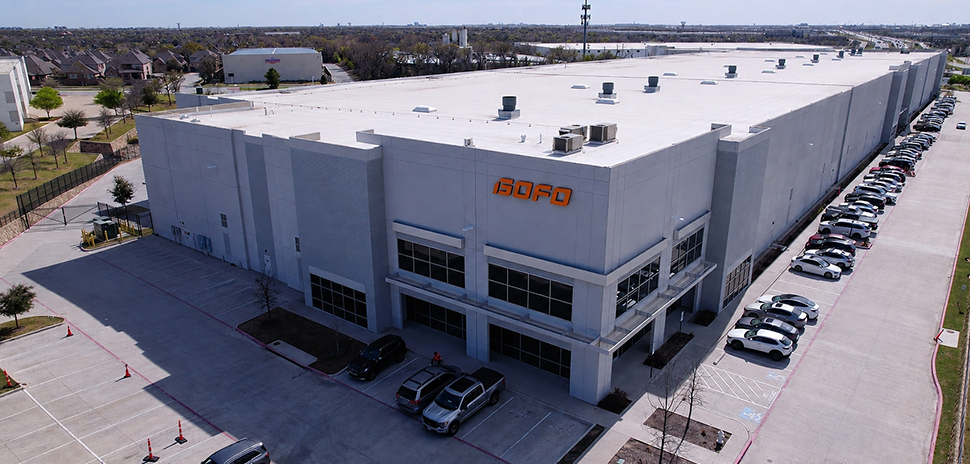
Dallas-based property tech company TestFit Inc. recently enabled the use of third-party AI tools to help evaluate and plan real estate projects.
On TestFit’s feasibility platform, an AI assistant like Claude or ChatGPT won’t generate building configurations or financial figures. Rather, it tells TestFit’s existing engine what outcome to target, the company said in a statement. TestFit customers include developers, brokers, architects, city planners, contractors, civil engineers and students.
“A developer can tell it to hit a yield target. A civil engineer can tell it to solve the grading,” Clifton Harness, co-founder and CEO of venture capital-backed TestFit, said in a statement. “Everyone gets the outcome their job needs as fast as they can ask for it.”
The new AI protocol
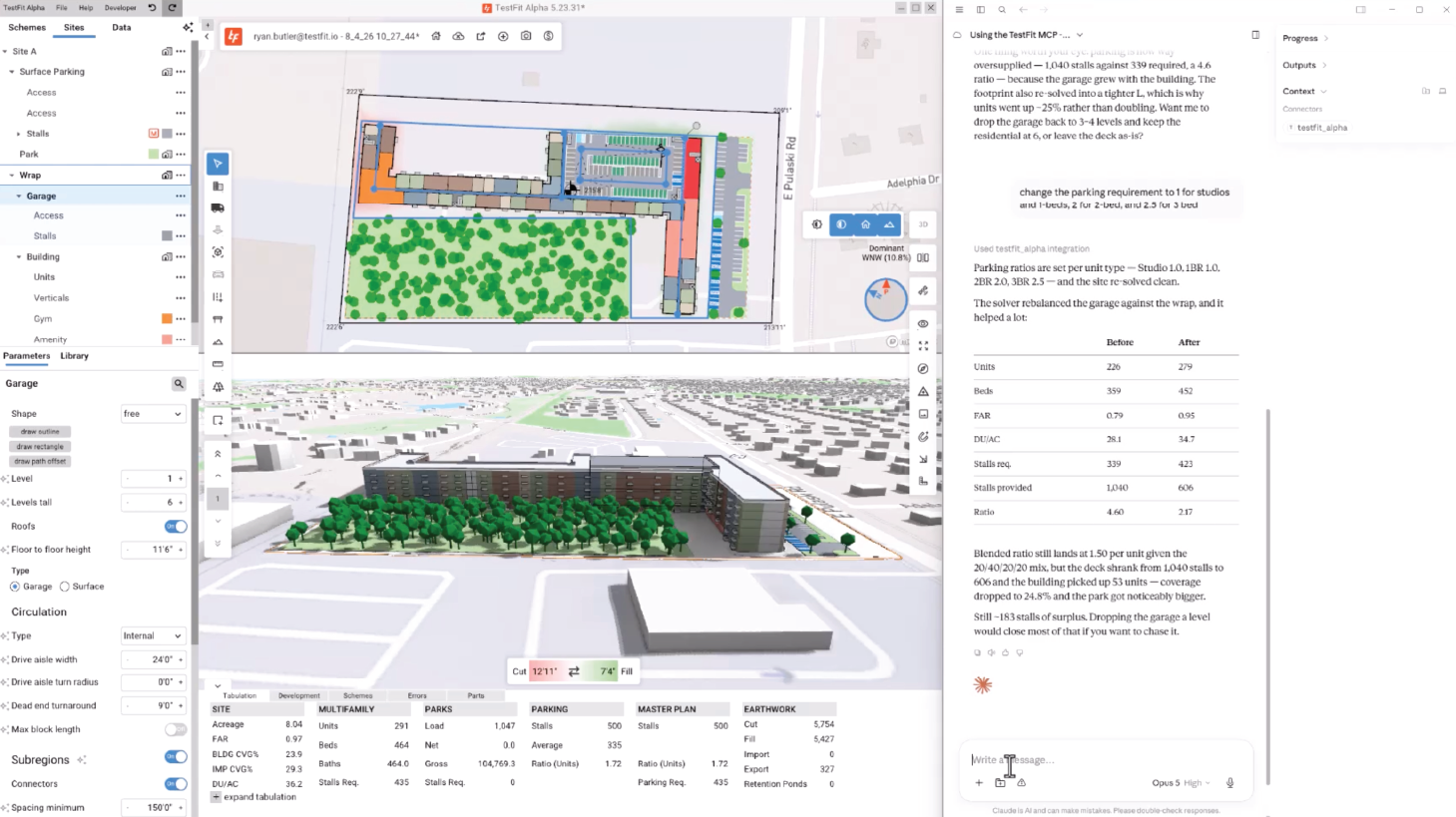
TestFit’s platform now allows users to connect AI tools like Claude and ChatGPT to assist with their work. [Photo: TestFit]
TestFit’s AI-powered platform helps people determine the feasibility of a real estate project. This includes projects in sectors such as multifamily, single-family homes, industrial, retail, hotel, parking and data centers.
The platform delivers real-time insights into elements like design, cost and ease of construction. Now, users can gain or tweak insights by connecting tools like Claude and ChatGPT to a TestFit feasibility study.
The platform’s new model context protocol, or MCP — widely adopted by the AI industry — lets AI assistants connect to external tools and data, TestFit said.
“Think of MCP like a USB-C port for AI applications,” the Model Context Protocol website said. “Just as USB-C provides a standardized way to connect electronic devices, MCP provides a standardized way to connect AI applications to external systems.”
A real-world example
TestFit provides the following example of how this might work.
Direct the platform to lay out a 300-unit, four- to five-story apartment building. Then plug in details such as parking ratio, zoning requirements and projected investment yields. This capability lets you test different project scenarios and generate details for a lender, a city planner and other people associated with a project. Third-party AI tools tied into the TestFit platform can help guide the entire process.
“We didn’t build TestFit on AI. We built the thing AI needed to run on,” Laura Paciano, chief growth officer at TestFit, said in a statement. She said the new protocol “skips the learning curve entirely. If you can say what you need out loud, you can use TestFit.”
Harness said the TestFit platform has always handled the complexities of real estate projects. Now, the new protocol allows a user to direct it, he said.
“You don’t need to know all 20-some disciplines or hunt for the specific tool built for yours,” the company said. “Tell TestFit what your job needs, and it delivers it.”
Built on an open standard
TestFit, founded in 2016, has raised $22 million to date, including a $20 million Series A in 2022 led by Parkway Venture Capital. The company said it built the AI functionality on a publicly available open standard so customers can use an AI tool they already trust without being locked into a single vendor.
“Because that connection runs through the customer’s own AI account, the conversation stays there, not on TestFit’s servers and not trained on [AI],” TestFit said.
The ‘trust fall’ factor
TestFit also said the ability to employ an AI assistant removes the “trust fall” factor. For instance, you might ask an AI language model to read files and sketch out a floor plan. But, the company said, this means relying on a model to do the reasoning and hoping it won’t invent an answer “that merely sounds right.”
“Users used to flip [these] toggles by hand,” TestFit said. “Now the AI does it for them, and TestFit’s engine still creates what’s feasible while the human stays in command of what’s real.”
R E A D N E X T
-
The Dallas-based Colossal Biosciences spinout, now valued at $3.8 billion, is preparing forecasting pilots in health and biosecurity as it scales the model behind its predictions.
-

The Frisco-built V-BAT maker put its Hivemind software in charge of three National Chung-Shan Institute of Science and Technology Mighty Hornet III unmanned aerial vehicles for a field demonstration.
-
The Dallas-based foundation is partnering with New York City worker advocacy nonprofit Lift Our Voices on the free Agentic AI Academy, a five-day pilot for community college learners.
-
Jitin Bhandari will lead the Richardson company’s move into a new class of cloud providers that rent out the specialized chips powering artificial intelligence.
-
Researcher Habeeb Olufowobi will lead a project to build a safety layer to ‘help scientists confidently use AI in some of the world’s most advanced research facilities.’ It is one of 278 projects in a new federal effort.
-

Irving-based Builders FirstSource led a $25.3 million Series A investment as part of a larger partnership with the Vancouver, Washington-based maker of AI software for residential construction.
-

New CBRE research points to a maturing tech workforce in North Texas, fueled partly by the Y’all Street financial services boom.
-
After 18 months of working with select enterprise customers, founder and CEO Kalyan Kommineni says its agents are helping supply chain teams recover margin, cut costs and respond to customers faster.
-

The Southlake-based workforce management software provider is expanding into major grocery and food service accounts as it rolls out new AI-powered planning tools. Over the next several months, the company is expanding deployments with major grocery and food service customers across North America and internationally.
-

The cumulative milestone reached by TrendAI, whose U.S. headquarters is in Irving, underscores how quickly AI is reshaping cybersecurity spending — and how the AWS Marketplace captures that growth.