UTA has landed a $450,000 gift from HF Controls to power new research at the intersection of nuclear engineering and artificial intelligence.
The funding supports work led by Yonghe Liu, professor of computer science and engineering, who is using AI to improve how nuclear plant control systems are developed, tested and validated. UTA said the research aims to boost safety and efficiency in one of the most heavily regulated areas of the energy industry.
“This generous investment from HF Controls reflects the power of academic and industry partnerships in driving innovation,” UTA President Jennifer Cowley said. “We are honored to work alongside HF Controls to advance research that addresses global energy needs.”
The gift also upgrades the HF Controls Student Success Center, known as “The Bughouse,” a tutoring and support hub in UTA’s Engineering Research Building that prepares computer science and engineering students for high-demand careers.
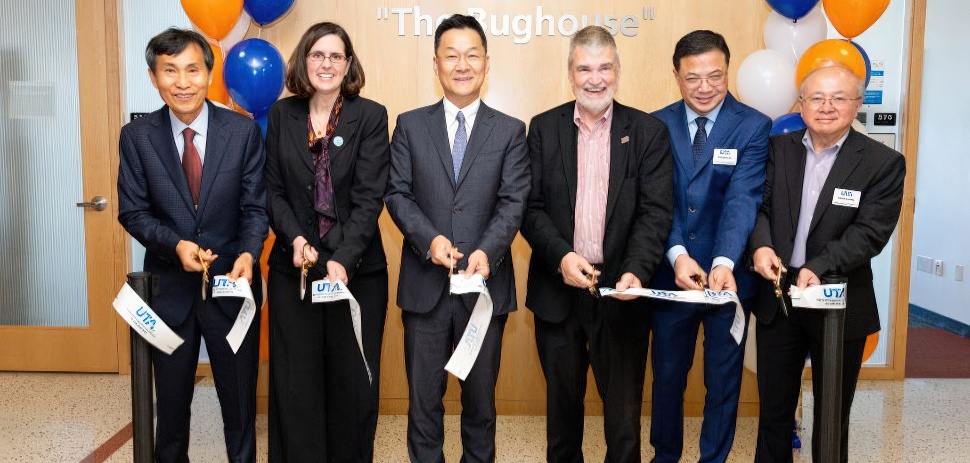
“Kook” Hun Kim, COO, HF Controls; UTA President Jennifer Cowley; Woosik Wynn Choi, CEO, HF Controls; Peter Crouch, dean, UTA College of Engineering; Yonghe Liu, professor, UTA Computer Science and Engineering ; and Hong Jiang, chair, UTA Computer Science and Engineering. [Photo: UTA]
“This strategic collaboration represents a visible reminder of HF Controls’ commitment to our students and to the future of nuclear engineering,” College of Engineering Dean Peter Crouch said. “Dr. Liu’s research is at the forefront of AI-driven safety systems, and this significant support will accelerate his work while preparing the next generation of engineers for professional success.”
HF Controls, which designs instrumentation and control systems for nuclear plants and industrial automation, said its partnership with UTA strengthens a shared focus on engineering innovation and safety.
“We are proud to partner with The University of Texas at Arlington to foster cutting-edge research and student excellence,” the company said in a statement.
Don’t miss what’s next. Subscribe to Dallas Innovates.
Track Dallas-Fort Worth’s business and innovation landscape with our curated news in your inbox Tuesday-Thursday.
R E A D N E X T
-
The brain-inspired design could lower the energy and compute costs behind AI training requirements, an increasingly urgent challenge for enterprises.
-
The new federal Alzheimer's hub joins an elite network of 37 centers nationwide. Scientists from UT Southwestern, UT Arlington, and UT Dallas will decode dementia by exploring hypertension's role, analyzing voice patterns with AI, and creating virtual patient models.
-

UTA and UT Southwestern researchers have built BIT, a new computational framework that helps scientists identify the proteins that switch genes on and off in cancer and other diseases. The work could pave the way to more targeted treatments and boost gene research accuracy.
-

The Cancer Prevention & Research Institute of Texas offers funding opportunities for promising cancer research, product development, and prevention programs. The state-funded initiative stands as the second-largest public backer of cancer research in the U.S. after the National Cancer Institute.
-
![Organoids without blood vessels can't grow larger than sesame seeds—about 3 millimeters—before dying from lack of oxygen and nutrients. UNT and Stanford researchers say they've solved this problem. Seeds pictured above are not to scale. [Image: Pinchai Puntong/istockphoto]](https://s24806.pcdn.co/wp-content/uploads/2025/08/Sesame-Seed-organoid-science-iStock-1487667097-970x464.jpg)
Scientists at at the University of North Texas and Stanford Medicine have created tiny artificial organs called organoids with fully formed blood vessel networks. The stem cell-based breakthrough could transform drug testing and disease research while reducing the need for animal models—and expand possibilities for regenerative medicine.