With biotechnology investment still mired in a post-pandemic bear market, Texas biotechs are working to stay competitive after a sharp decrease in funding last year. But new state laws, the rise of artificial intelligence, and the prospect of federal initiatives, including regulatory reform, have some feeling more optimistic about the sector’s future.
That was the consensus of multiple experts at the 2025 iC3 Life Science & Healthcare Innovation Summit in Dallas last week. Presented by BioNTX, a North Texas bioscience and healthcare innovation organization, the summit was held September 16 and 17 at the Hilton Anatole hotel.
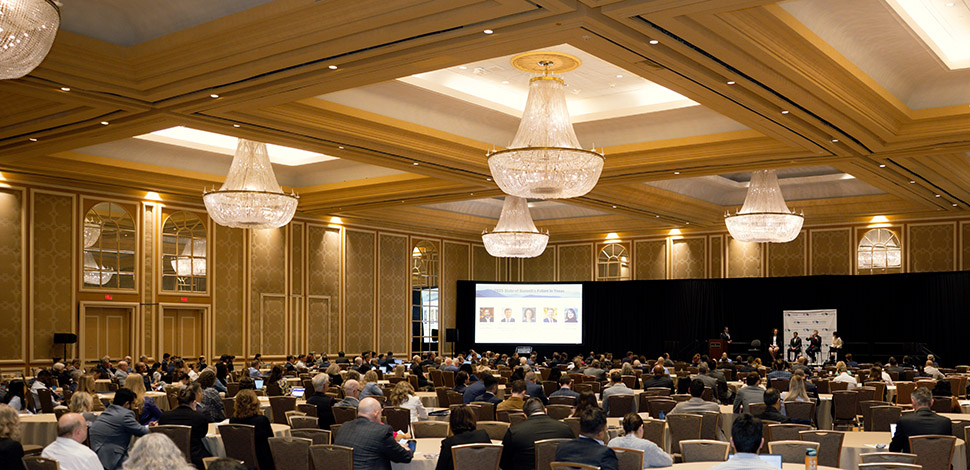
The 2025 BioNTX iC3 Life Science & Healthcare Innovation Summit drew biotech leaders from across Texas and the nation to the Hilton Anatole in Dallas. [Photo: BioNTX]
During a series of panel discussions, speakers outlined the funding headwinds biotechs are facing, including one unearthed by the Texas edition of the EY Biotech Beyond Borders Report 2025. “More than half of the public biotechs based in Texas have less than one year of cash, and another 25% have less than two years of cash on hand,” the report said.
That matters, not least because the industry is a major driver of targeted therapies—especially for cancer, which accounted for 40% of all clinical trials in Texas last year, according to the EY report. Biotech also is a source of many high-paying jobs across the state.
The city of Dallas, for example, is home to growing, nationally known life sciences companies like Colossal Biosciences, the burgeoning Pegasus Park biotech and life sciences campus, and one of just three ARPA-H hubs in the U.S. for fast-tracking biotech breakthroughs. With weaker funding flows, ecosystems across Texas and the country risk losing momentum.
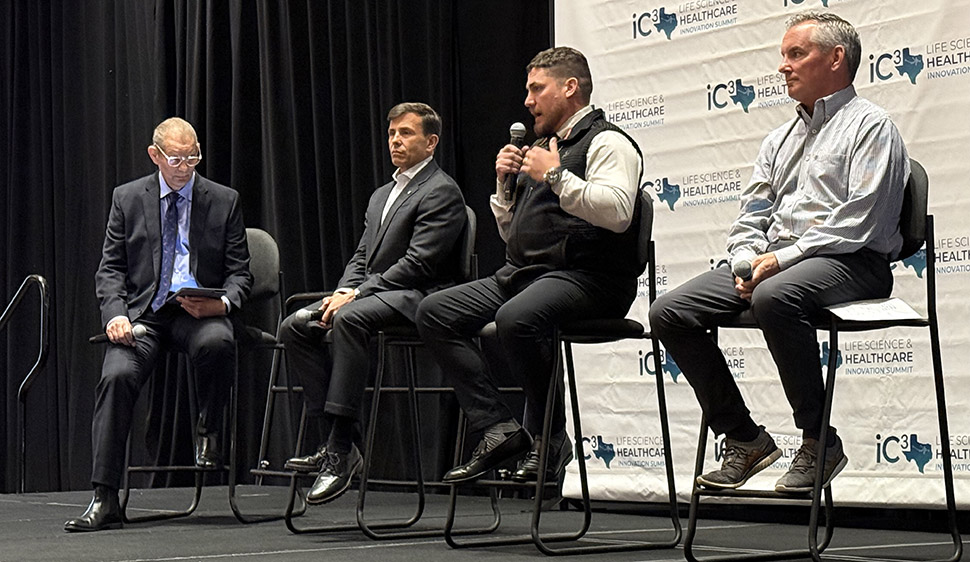
Biosecure: Innovation at the Edge of Risk, Regulation and Resilience” panelists at the iC3 Summit were, from left, moderator Milton De La Paz of DFW International Airport, John Crowley of the Biotechnology Innovation Organization, Steve Hernandez of The North Group, and Joe Nolan of Jaguar Gene Therapy. [Photo: Glenn Hunter]
Contributing to biotech’s investment hurdles are a “mostly closed” IPO window and lower M&A deal values, due to factors such as rising interest rates and regulatory cost pressures, experts and the EY report said.
However, the biggest reason for biotech’s current challenging environment is “because the model is broken,” said John Crowley, president and CEO of the Washington, D.C.-based Biotechnology Innovation Organization.
“I think the capital struggle has been symptomatic of a system that simply takes too long, costs way too much money, where there’s too much uncertainty and too much inconsistency in the regulatory process,” Crowley said.
For decades, he explained, the model has been to license technology out of a university, line up angel and venture investors, pour in tens or hundreds of millions of dollars over 10 or 20 years to develop a product, “spend $1 billion to do it, and then in the end maybe you can revenue in a profitable company 20 years out. That math just doesn’t work anymore.
“Now we have to think about how we can make the system more efficient.”
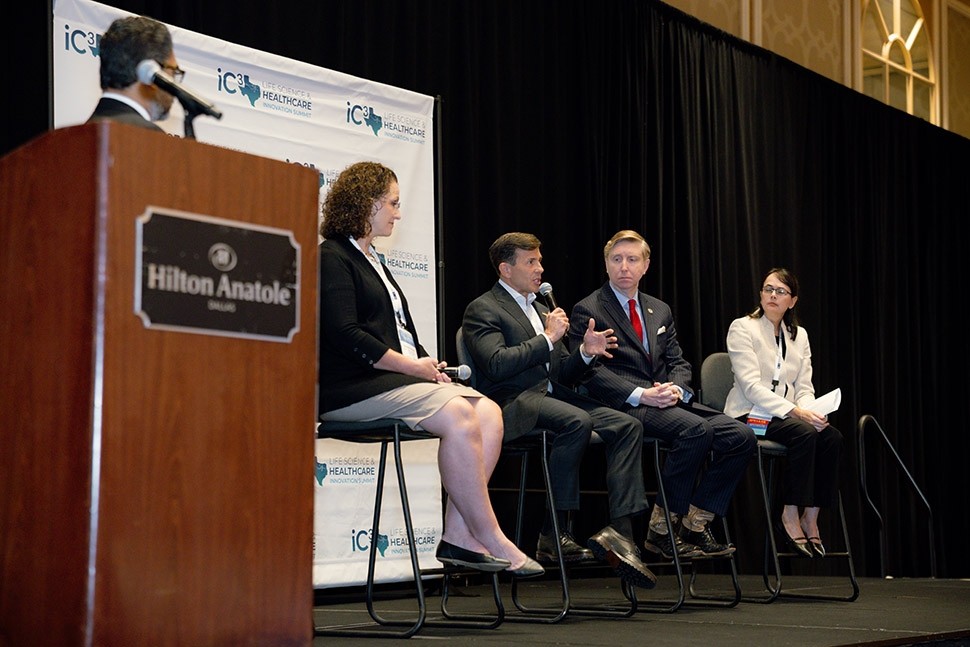
The iC3 Summit’s “2025 State of Biotech’s Future in Texas” featured panelists, from left, Panna Sharma of Lantern Pharma, who served as moderator; Victoria Ford of the Texas Healthcare and Bioscience Institute; John Crowley of the Biotechnology Innovation Organization; State Sen. Tan Parker; and Luciene Schafer of Ernst & Young. [Photo: BioNTX]
The promise of Prop 14
State Sen. Tan Parker, R-Flower Mound, who’s led initiatives in the Legislature on AI, cybersecurity, and capital markets, agreed that the drawn-out process can crimp innovation and entrepreneurship. Even so, he suggested that biotech may be better positioned to succeed in North Texas because of the region’s Tier 1 universities, world-class workforce, the Pegasus Park development—and Dallas’ burgeoning “Y’all Street” financial sector.
“Now Texas will be the home of the capital markets … for all of America,” Parker said. “It will be incredible. And what you’ll see occur right here in the heart of Dallas, right here in the heart of the metroplex, will drive the biotechnology sector.”
Another panelist, Victoria Ford, also saw hopeful signs for the regional ecosystem in recently passed state legislation—Senate Bill 856—to expand the use of Texas Skills Development Fund money to include skill development in biotechnology.
Ford, president and CEO of the Austin-based Texas Healthcare and Bioscience Institute, was encouraged as well by Proposition 14, a proposed amendment to the Texas constitution that would establish the Dementia Prevention and Research Institute of Texas (DPRIT). Prop 14, which will be on the Nov. 4 ballot, would create a $3 billion fund to support research and treatment for the likes of dementia and Alzheimer’s disease.
Ford compared DPRIT to the state’s Cancer Research and Prevention Institute (CPRIT), which she said “dramatically expanded oncology research” in Texas and made it “the world leader” in fighting cancer. Prop 14 proponents say the amendment will do the same for dementia, Alzheimer’s, and Parkinson’s disease, positioning Texas at “the forefront of scientific breakthroughs” and make Texas a hub for brain research.
Panelists, including Parker, said that by speeding up the review process for biotech innovations, among other things, artificial intelligence holds great promise for bolstering the life sciences as well. Already, they said, the FDA has approved more than 1,000 AI-enabled medical products.
“I think [AI] will have tremendous impact in the pharmaceutical industry, the device industry, because it can evaluate potential candidates or come up with potential drugs at a scale that would be very difficult for a human to replicate,” said Charles Taylor, Ph.D., the Moncrief Chair in Computational Medicine at The University of Texas at Austin.
AI’s potential has yet to be fully exploited in biotech manufacturing, added Panna Sharma, president and CEO of Dallas-based biotech Lantern Pharma.
“We have so much great technology and automation, and we fail to deploy it,” he said. “Drug manufacturing should be automated. There should be four or five people, and they should produce millions and millions and millions of available drug product. We’re still doing stuff in vats and vials and having people run around and check-mark stuff. ‘Like, what are you doing?! Do you even know what you’re looking at?!’ It just boggles my mind.
“The biggest impediment to dominating in AI today is ourselves.”
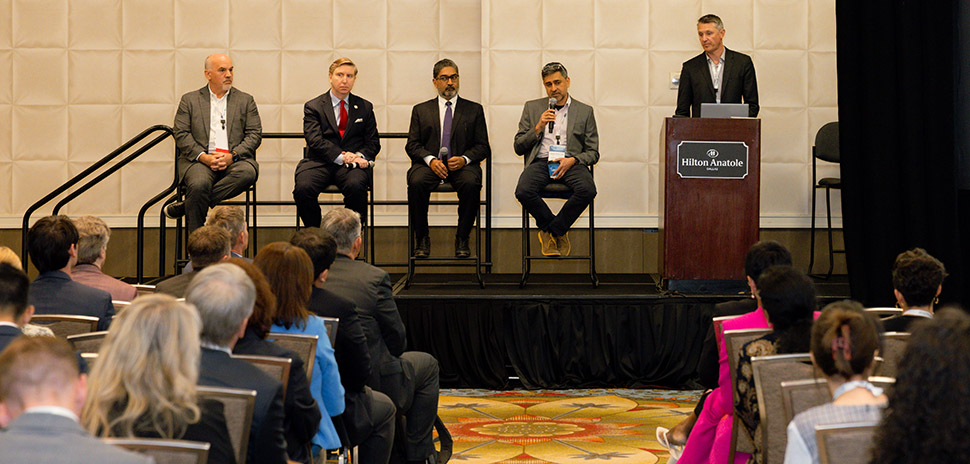
Panelists for the iC3 Summit’s “AI in the Golden Age of Biotech: Shaping the Future of Innovation” session were, from left, Charles Taylor of The University of Texas at Austin, State Sen. Tan Parker, Panna Sharma of Lantern Pharma, Deloitte’s Raveen Sharma, and moderator Jason Wietjes of Polsinelli. [Photo: BioNTX]
‘The assault is tremendous’
America’s biotech industry also will need to look inward in order to retain its dominance over China, Crowley said. In contrast to the U.S.—where drawn-out schedules and excessive bureaucracy can hamper timely drug development—China’s process expedites development, he said.
He cited the case of a competitive, Chinese-developed cancer medicine that was supported by “quality patient data” in China within 18 months. “That’s about a five-year study in the United States,” he said. “It’ll never be 18 months here, but can we make it three years, or four years at least? I think we can.”
He said that, a decade ago, there were about 100 Chinese companies doing sophisticated biotech work. Today there are at least 3,000 innovative Chinese biotechs that have collectively raised hundreds of billions of dollars, Crowley said.
He also mentioned the threat posed by China’s widespread theft of U.S. intellectual property and trade secrets.
“We need to make sure we’re hyper-vigilant in our industry to protect our innovation. We’re getting better at that, but the assault is tremendous,” Crowley said. “So, stop the unfair competition in China. Recognize what they’re doing in terms of the relatively fair competition, but then focus inward in the United States and fix our own house.”
Another panelist seconded Crowley’s counsel for more self-reflection. Joe Nolan, president and CEO of Illinois-based Jaguar Gene Therapy, pointed to the requirement for companies like his to do three Process Performance Qualification batches—or product runs—within the validation framework for manufacturing.
“On a rare disease drug, three batches could be five years of product,” Nolan said. “We don’t need to waste that money. Why does it have to be three? What’s the magic number of three? Or maybe the batches can be smaller. There are shortcuts and efficiencies that we can do to keep us innovative.”
Toward that end, Crowley referenced an important, recently released final report by the National Security Commission on Emerging Biotechnology. Among its many recommendations, the bipartisan federal report called for establishing a $15 billion U.S. biotech fund and developing a network of biotechnology manufacturing hubs across the country.
It also proposed enhancing incentives for private biotech investment and streamlining regulatory processes to accelerate the commercialization of innovations.
“How can we break down the permitting, the environmental rules and regulations—not to undercut them, but to fast-track them?” Crowley said. “It’s about speed.”
Meantime, the Texas EY report concluded that biotechs will need to become more agile in order to succeed. “Texas remains a compelling microcosm of the global biotech sector: innovative, capital-constrained, and forced to do more with less,” the report said. “The companies that emerge stronger will be those that embrace efficiency, adapt to deglobalization, and align closely with shifting investor and patient expectations.”
Don’t miss what’s next. Subscribe to Dallas Innovates.
Track Dallas-Fort Worth’s business and innovation landscape with our curated news in your inbox Tuesday-Thursday.
R E A D N E X T
-
 North Texas Innovation Is Boundary‑Breaking. Nominations for the Awards That Prove It Close Sept. 12
D CEO and Dallas Innovates have expanded The Innovation Awards 2026 with more individual and company categories this year. Now is your chance to be part of the region’s defining recognition for innovators.
-

AI seem overwhelming? Just go to office hours.
-

North Texas has plenty to see, hear, and watch. Here are our editors' picks. Plus, you'll find more selections to "save the date."
-
Data scientist Anmolika Singh put Dallas on the global AI Tinkerers map. At the first meetup, more than 30 pros—founders to Fortune 500 technologists—showed up to trade ideas, projects, and solutions.
-
Dallas Innovates, in partnership with the Dallas Regional Chamber, once again is recognizing the most innovative leaders in AI in Dallas-Fort Worth. From visionaries and mavericks to transformers and academics, AI 75's class of 2025 are the AI pacesetters you need to know now.