MORE►
beacons
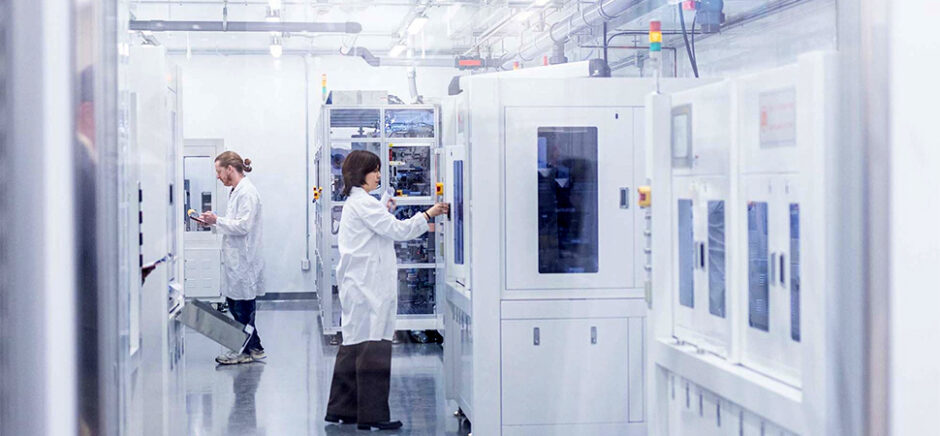
Lab assistants work in the cell assembly room at UT Dallas’ BEACONS facility, where specialized features support the assembly of solid-state and other advanced battery chemistries. [Photo: UT Dallas]
Inside BEACONS: UT Dallas’ New Pentagon-Backed Hub for U.S. Battery Technology
by Quincy Preston and Lance Murray | Jul 22, 2025
Backed by the Department of Defense and $200 million in private capital, the new facility helps companies prototype and scale battery technologies for both commercial use and national defense. The launch comes at a time when supply chain independence is a growing priority.
Government and industry leaders recently got a first look.
by Lance Murray |
Jun 4, 2025
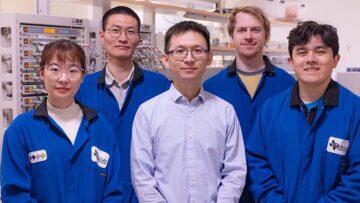
The UT Dallas team found that mixing small particles between two solid electrolytes can generate an effect called a “space charge layer"—an accumulation of electric charge at the interface between the two materials, making it easier for ions to move across the interface.
MORE►
by David Seeley |
Sep 18, 2023
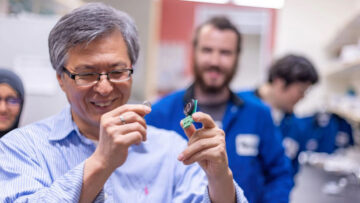
The $30 million UTD-led project aims "to accelerate the transition and scaling of next-generation batteries," while reducing dependence on scarce critical materials. Led by UTD biology professor Dr. Kyeongjae Cho, the initiative will include the construction of a new research facility at the Richardson IQ.
MORE►