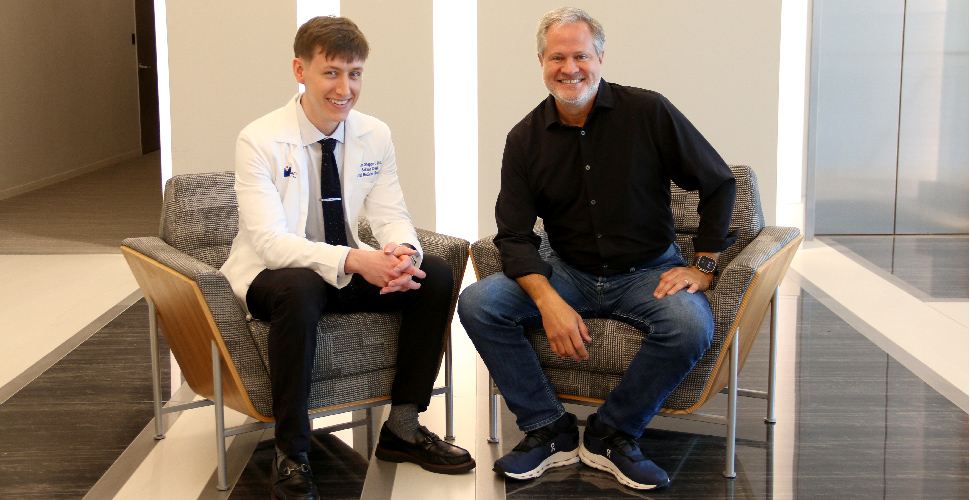
A physician-AI researcher and the designer behind some of the world’s most popular mobile apps are teaming up to improve the quality of healthcare with NEW PX, Dallas-based Matic’s reimagined experiences for “the three P’s: patients, practices, and physicians.”
Matic is also emerging from stealth. The company was formed after CEO Calvin Carter acquired Utah-based ScribeMatic, an AI healthcare documentation startup, in April 2025. Carter, who built Bottle Rocket into a mobile-app powerhouse later acquired by WPP and co-founded Dallas Opportunity Partners, has since rebranded the company as Matic.
The company was founded by Dr. Alex Sheppert, an AI programmer who became a medical doctor and experienced the burden modern healthcare places on physicians firsthand, giving him both the knowledge and insight to build systems that truly support physicians.
Carter and Sheppert—who serves as Matic’s chief technical officer—developed an AI-native clinical intelligence platform that helps manage electronic health records (EHRs) so that “patients get more attention, physicians get their time back and practices capture the full value of the care they deliver,” the company said.
“Human-centered design is at our core,” CEO Carter said in a statement. “We have reimagined the experiences for what we call the three P’s: patients, practices and physicians. That means before we built anything, we shadowed, interviewed and learned what it was like to be each of these stakeholders. Then we built, deployed and tested solutions repeatedly until we were sure that we served all three simultaneously. That is what we call the NewPX.”
From living the problem to solving the problem
Designed to be integrated with the EHR for primary care and specialty groups, NEW PX aims to remove “complexity, frustration, and friction” from the process of delivering care.
Healthcare organizations have been working to reduce physician workload, improve patient experiences, and drive practice performance, often treating each as a separate challenge. Matic offers an AI-driven workflow to solve all three, improving the quality of care while strengthening the relationship between patients, physicians, and the practice itself.
“I built Matic because I lived the problem,” Sheppert said. “I know what it feels like to spend the evening finishing notes instead of being with my family, to spend a visit looking at a screen instead of at a patient. Care teams do not need one more thing to manage. They need their time, and their attention, back. That’s what we delivered to them today.”
Matic said NEW PX is ultimately an engagement platform, designed for easy adoption, delivering instant value and building habitual usage.
“The best solutions are the ones that get used, and Matic delivers the consistent engagement necessary to drive serious results,” said Carter.
Giving physicians ‘superpowers’
Built on Matic Intelligence, the engine behind everything Matic does, specialized agents address the full continuum of care, including panel management, chart summarization, burden of illness, care plan development, medical decision support, scribing, clinical evidence, research with patient context, clinical documentation, coding, and intelligent referrals.
Agentic AI takes care of the busywork “so physicians can focus on the patient and practices can optimize care,” the company said.
“Matic gives physicians superpowers so they can operate at the top of their license, and we take care of everything else,” said Carter.
Matic said it is built on the belief that “if a physician is truly engaged, properly empowered and allowed to focus on their patients, everyone wins.”
Operating throughout the continuum of care
According to Matic, here’s how the solution works:
:: Everyday, Matic scans the full patient panel to discover possible care gaps, identify potential issues, and develop proactive care plans with cited evidence.
:: Before the visit, Matic prepares for the appointment, tagging relevant history, pertinent labs and medications, possible care gaps, and risk factors so physicians and care teams walk in prepared.
:: During the visit, Matic captures the conversation through ambient documentation and offers clinical evidence and decision support in the moment, without interrupting the encounter, all based on the up-to-date context of the patient.
:: At the end of the visit, Matic aligns documentation and coding while the context is still fresh, generating suggested CPT, ICD-10, and E/M codes with modifiers and audit-ready justifications, tailored to payer rules.
:: After the visit, Matic prioritizes follow-up, care coordination, and patient communication with full clinical context attached, and helps teams manage panels and population health so nothing falls through the cracks.
Because the phases move together rather than in isolation, information gathered at one step can inform the next, Matic said.
Don’t miss what’s next. Subscribe to Dallas Innovates.
Track Dallas-Fort Worth’s business and innovation landscape with our curated news in your inbox Tuesday-Thursday.
R E A D N E X T
-

North Texas has plenty to see, hear, and watch. Here are our editors' picks. Plus, you'll find more selections to "save the date."
-
Because of the explosion in the use of artificial intelligence throughout society, the legal industry is undergoing seismic change, and the profession needs ways to build the judgment, confidence, and fluency to use AI effectively, BARBRI said.
-

Nine student and alumni teams made the finals in three tracks: undergraduate, graduate student, and alumni. Winning ideas ranged from AI sales coaching to radiation mapping and noninvasive brain drug delivery as the university’s entrepreneurship push continues to scale.
-
Cartesian's global footprint includes London, Boston, New York, and Paris, with several hundred experts supporting clients in key international markets, primarily in North America and EMEA. The combined organization has more than 5,000 specialists across AI services, data, analytics, cloud, and user experience, serving a diverse portfolio of Fortune 1000 companies and global enterprises.
-
The DECA Dental founder returned to his alma mater to keynote UT Dallas' record-breaking Draper Pitch Competition. He told student founders what it really takes.
-

Travis Machen, CEO and group head of global banking and markets at Scotiabank, said the acquisition "further supports our strategic focus within the North American corridor."
-

The Dallas-based reproductive health platform offers a cycle-tracking app for logging cycles and managing conditions like endometriosis and PCOS. It was one of five finalists taking part in North Texas' premier social innovation competition.
-
“Dallas is a city on the rise—a magnet for capital, talent, and ideas," Luisa del Rosal said. "I look forward to working with the board, our members, and partners to amplify ECD’s role as a premier forum for the conversations that will define our economic future."
-

The MGUSD stablecoin enables MoneyGram to offer stable value, lower costs, instant access, and reliable, easy-to-use financial tools, engineered not for crypto natives, but for the billions of people who move money across borders every day or who don't have access to local financial services, the company said.
-

The extended agreement with Virginia-based BWX Technologies is only the latest of decades of moves by ATI to support the nuclear propulsion program—which maintains "cradle-to-grave" responsibility for the research, design, construction, operation, maintenance, and eventual disposal of all nuclear reactors used in U.S. Navy submarines and aircraft carriers.