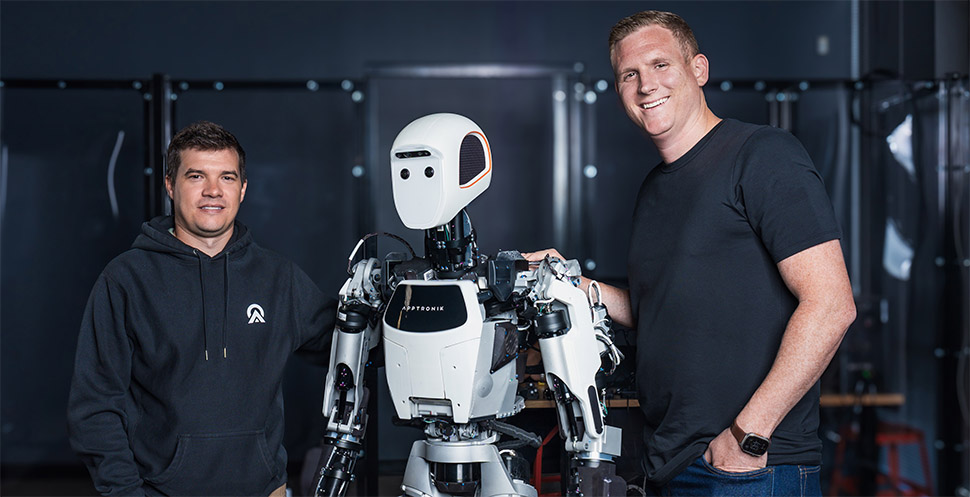
AT&T Ventures has invested in Austin-based humanoid robotics company Apptronik, which today announced a $520 million Series A-X extension, bringing its total Series A funding to more than $935 million, according to the company.
With total capital raised approaching $1 billion and a reported post-money valuation of roughly $5.3 billion, Apptronik now ranks among the most heavily funded humanoid robotics startups in the world.
“Today’s investment is a strong vote of confidence in our mission to deliver humanoid robots that are designed to work alongside humans, not just as tools but as trusted collaborators,” Jeff Cardenas, co-founder and CEO of Apptronik, said in a release.
The company said it opened the extension at a 3-times multiple of its original Series A valuation after continuing to receive what it described as “substantial inbound investor interest.”
The new round includes participation from existing investors B Capital, Google, Mercedes-Benz, and PEAK6, alongside new investors including Dallas-based AT&T Ventures, John Deere, and Qatar Investment Authority (QIA), Apptronik said in its Feb. 11 announcement.
Vikram Taneja, head of AT&T Ventures—the Dallas-based venture capital arm of AT&T that invests in early-stage companies across connectivity, IoT, and artificial intelligence—said the Apptronik bet aligns squarely with the firm’s thesis.
“We view humanoid-form ‘physical AI’ as a powerful way to pair advanced robotics with the scale and flexibility of next-gen connectivity,” Taneja wrote on LinkedIn. He described the raise as “a huge validation of the team, the Apollo platform, and the broader humanoid robotics category.”
Capital Factory’s early bet
Apptronik said the extension follows a $415 million oversubscribed initial Series A in 2025. The round was originally announced at $350 million and co-led by B Capital and Austin-based Capital Factory. In March 2025, the company said it expanded that raise to $403 million.
At the time, Bryan Chambers, the Dallas-based president and co-founder of Capital Factory, wrote on LinkedIn that if ChatGPT had it right, Apptronik’s earlier Series A was the largest Series A round in Texas history—calling it “a fun fact that Capital Factory and Apptronik should be proud of.”
Capital Factory does not typically lead investment rounds, Chambers noted, but this one was different. It was “one that every bit of my blood, sweat, and tears went into,” he wrote, crediting partners including Chris Camillo, Gordon Daugherty, Jamie Serio, CFA, Josh Baer, and Steve Brotman.
Camillo, the Dallas-based co-host of Dumb Money and an early backer of Apptronik, echoed that conviction. He posted on LinkedIn that he has been “12 months deep with this low-ego, high-conviction team, from first deck to final wire.”
“Proud we pulled it off with zero manufactured hype,” Camillo added. “Wait till you see what they’re cooking.”
That enthusiasm carried onto the stage at the 2025 Venture Dallas conference last fall, where Camillo interviewed Apptronik CEO Jeff Cardenas about the future of humanoid robotics.
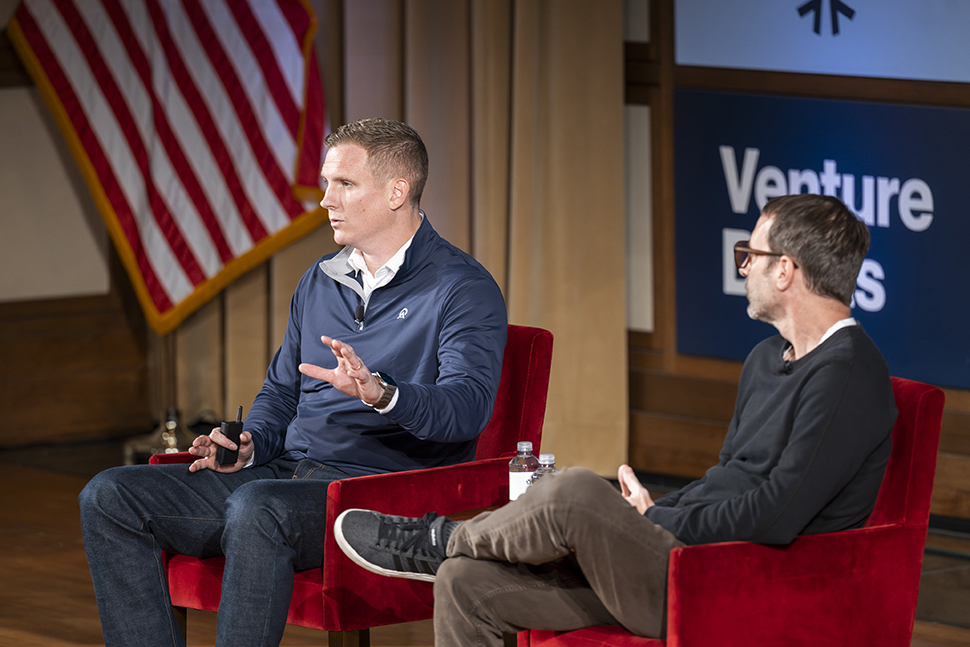
Apptronik CEO Jeff Cardenas and investor Chris Camillo at Venture Dallas in October 2025. [Photo: Grant Miller Photography/Venture Dallas]
“A big part of your cap table are Dallas investors,” Camillo said, gesturing to the room, many of whom were in the audience.
The conversation framed humanoid robotics as what Cardenas described as the next great global technology race, one that Dallas investors are now materially backing.
Riding the ‘AI wave’
Cardenas, a Dallas-area native who attended Coppell High School, described waiting a decade “on my surfboard” for the AI wave to arrive. In the company’s early days, Apptronik built exoskeleton “Iron Man suits” for U.S. Special Forces. Since then, it has averaged roughly a new humanoid robot each year, completing more than 10 iterations while artificial intelligence caught up to the hardware.
Camillo told the audience that when he made his first investment, “I wrote the first check and literally marked it down to zero on my spreadsheet,” underscoring just how speculative humanoid robotics seemed at the time.
Since then, he has become one of the company’s most vocal believers, previously predicting that humanoid robotics platforms could ultimately create trillion-dollar divisions inside major companies.
Cardenas, who founded Apptronik in 2016, told the crowd the company’s goal is far bigger than building a single machine. “We’re building general-purpose humanoid robots that can operate in the real world,” he said, describing a long-term vision that stretches from industrial deployments to eventually working inside homes.
The field, he said, is as much a race between countries as companies.
China should be taken seriously, Cardenas said, adding that the U.S. must compete aggressively in advanced robotics.
“For national competitiveness and national security, this is the most important thing to be working on,” Cardenas said. “This is the space race of our time.”
Scaling Apollo
Apptronik said the fresh capital will allow it to ramp up production of Apollo, expand its global network of commercial and pilot deployments, and build next-generation facilities for robot training and data collection.
At Venture Dallas, Cardenas laid out a phased path from pilot programs to scaled deployment. The company is focused first on industrial environments—manufacturing, logistics, and warehouse operations—where repetitive labor shortages are most acute. From there, he said, the roadmap expands into sectors such as health care and, longer term, education and the home.
Cardenas noted industrial pilots through 2026, using early commercial deployments to refine hardware, autonomy, and data training systems. Broader scaling, he added, is expected “in 2027 and beyond.”
The near-term goal is reliability and repetition, he said, getting robots to consistently perform real-world tasks inside controlled commercial environments. Longer term, he described building general-purpose humanoids that improve through real-world data collected from deployments.
Apptronik said the Apollo humanoid is designed to perform physically demanding and repetitive tasks in manufacturing and logistics environments, including transporting components, sorting, and kitting. The company has partnerships with Mercedes-Benz, GXO Logistics, and Jabil, and maintains a strategic partnership with Google DeepMind to build the next generation of humanoid robots powered by Gemini Robotics.
Apptronik, which spun out of the Human Centered Robotics Lab at the University of Texas at Austin, has nearly 300 employees and has developed 15 prior robots, including NASA’s Valkyrie, a humanoid robot built for the DARPA Robotics Challenge.
A future where humans aren’t alone
When asked about the technology’s long-term potential at Venture Dallas, Cardenas drew parallels to the early days of computing, when critics feared centralized supercomputers would eliminate jobs and concentrate power.
“There was this idea of a supercomputer that would be at the center of a company and there’d be four people working there, and it would replace all the jobs,” he said. Instead, computing expanded opportunity. “What computers did was augment humans,” Cardenas said. “Everyone is carrying a computer in their pocket, maybe on their wrist.”
He believes robotics will follow the same trajectory, that combining humans with these technologies “augments and improves quality of life for everyone.”
Cardenas said he’s particularly excited about applications in health care and aging care, as well as space exploration. “One of the worst parts of human life is how we age,” he said.
To describe the broader arc, he turned to science fiction writer Isaac Asimov, quoting a passage that shaped his thinking: “There was a time when humanity faced the universe alone and without a friend. Now he has creatures to help him, stronger creatures than himself, more faithful, more useful and absolutely devoted to him. Mankind is no longer alone.”
For Cardenas, that future isn’t abstract. “We’re trying to build a future where humans as tool makers now have the capacity to create things that can help us,” he said. “I think it’s the very beginning, and I’m really excited to build it right here in Texas.”
Don’t miss what’s next. Subscribe to Dallas Innovates.
Track Dallas-Fort Worth’s business and innovation landscape with our curated news in your inbox Tuesday-Thursday.
R E A D N E X T
-

North Texas has plenty to see, hear, and watch. Here are our editors' picks. Plus, you'll find more selections to "save the date."
-

At a kickoff event held at JPMorgan Chase ahead of the 2025 Inclusive Capital Summit, the announcement of Impact Ventures' new CDFI fund set the tone for a two-day gathering focused on the future of capital, inclusion, and community-driven growth.
-
![Social entrepreneur Byron Sanders, a former nonprofit exec, is CEO of Arete Health, launched in January 2025. [Photo: Michael Samples]](https://s24806.pcdn.co/wp-content/uploads/2025/10/27_ByronSanders-STEM-STEAM-STREAM-970_courtesy_Oct2019-1.jpg)
Creatives Care Dallas brings virtual care, behavioral health, 2,000+ medications with zero copay, and more to Dallas County's gig workers. The community initiative is powered by Arete Health Shield in partnership with the Dallas Music Office.
-
 North Texas Innovation Is Boundary‑Breaking. Nominations for the Awards That Prove It Close Sept. 12
D CEO and Dallas Innovates have expanded The Innovation Awards 2026 with more individual and company categories this year. Now is your chance to be part of the region’s defining recognition for innovators.
-

A familiar figure in Dallas arts, civic innovation, and public service, Cuellar will succeed longtime CEO Tony Fleo following a months-long search as Social Venture Partners Dallas plans its next 25 years.