We’re all familiar with local weather reports warning of the risk of wildfires in North Texas, as hot weather and dry conditions can turn a tiny spark into a raging inferno capable of consuming untold acres of land.
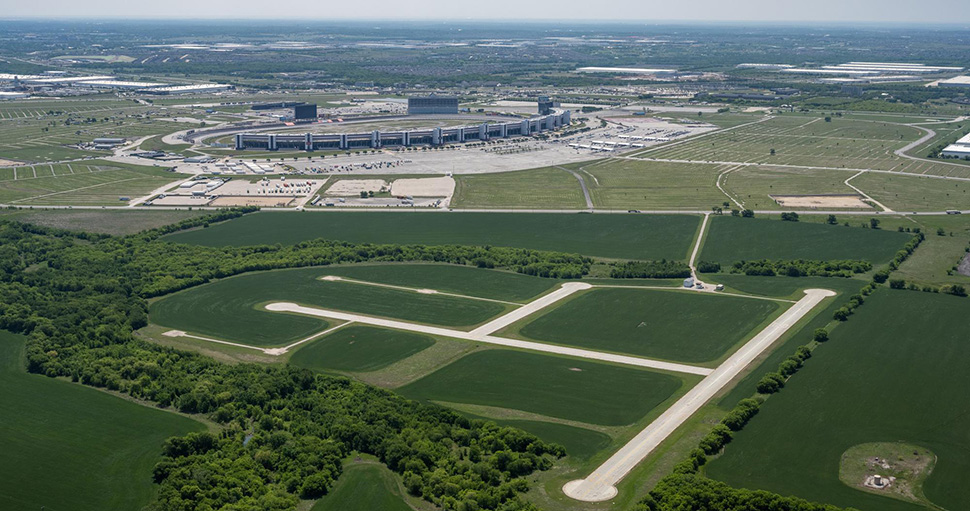
Recently, a large-scale exercise was held at Texas Motor Speedway and AllianceTexas as drones and helicopters filled the skies to battle a simulated wildfire. But, unlike traditional operations, each aircraft was directed by advanced, fully autonomous technologies.
The simulation, held in late August, was an exercise in precision and coordination led by a team of North Texas organizations.
AllianceTexas said that while one team of robotic aircraft located the simulated fire, another identified water sources for refilling. Then, working in unison, the drone teams coordinated which fire targets to attack first, how to avoid one another, and also how to deconflict with any rogue aircraft in the area while repeating the firefighting cycle.
The development process
According to AllianceTexas, in January 2024, the North Texas Cohort, led by the University of North Texas, received a two-year contract from the North Central Texas Council of Governments (NCTCOG) to continue Advanced Air Mobility (AAM) research across Dallas-Fort Worth-Denton.
The program, called Advanced Air Mobility/Urban Air Mobility System Within the Dallas-Fort Worth Metroplex (NTXAAMPP), was focused on designing, testing, and demonstrating advanced air corridor systems in the DFW and Perot Field Alliance Airport region.
AllianceTexas said the work builds on three years of prior NASA and U.S. Air Force AAM research and development.
The August operation, called FIRE SWARM 2 was the latest in a series of increasingly complex trials and highlighted the BlueSkies Operational Air Mobility system—a hardware/software solution that enables manned and unmanned aircraft to coordinate and safely execute complex maneuvers in metropolitan airspace or wildfire conditions.
The BlueSkies Operational Air Mobility (OAM) system is developed by Unmanned Experts, a technology company specializing in drone and autonomous systems.
More on the exercise
During the exercise, AllianceTexas said a simulated fire was detected near Hillwood’s AllianceTexas Flight Test Center, west of Texas Motor Speedway. An Incident Command Center was established to manage the operation, AllianceTexas said.
Autonomous search drones were deployed to scan the designated “fire traffic area,” while air corridors and routing were created for a swarm of “water bomber” aircraft. Those bombers, professionally piloted Bell 505 helicopters from the Helicopter Institute fitted with BlueSkies, received assignments via CivTAK tablets, AllianceTexas said.
The water bombers autonomously flew to their designated refill sites, safely deconflicted from one another by the system, and coordinated with search drones to update fire locations and simulate retardant drops at critical points.
When done, they returned for retasking as new aircraft cycled in.
The mission was a success, marking two firsts in aviation. AllianceTexas said.
It was the first live demonstration of small drones operating under FAA-compliant Unmanned Traffic Management software, interacting seamlessly with larger aircraft running NASA-designed Provider of Services for UTM software.
And it was the first fully autonomous, multi-aircraft, multi-operator live flight operation demonstrating vehicle-to-vehicle communications in the air, AllianceTexas added.
Next steps and team
AllianceTexas said the FIRE SWARM team will close out the NTXAAMPP project in coming months but will continue to advance AAM development with partners including NASA’s Advanced Mobility Pathfinder (AMP) project, Texas A&M’s CROW program, and the FAA’s UTM Operational Evaluation Key Site initiative—all of which are Texas-based.
The North Texas Cohort includes Hillwood and Alliance Aviation Services, which owns and operates the AllianceTexas Flight Test Center; the Helicopter Institute as the air platform, crew, and training partner; Avianco as one of the PSU providers; Metron as the demand-capability balancing software developer; Hermes as the primary data-hub; AAMTEX as the UTM and weather service provider; the University of North Texas as the program lead; and Unmanned Experts Inc. as the program manager, and BlueSkies development and marketing team.
Don’t miss what’s next. Subscribe to Dallas Innovates.
Track Dallas-Fort Worth’s business and innovation landscape with our curated news in your inbox Tuesday-Thursday.
R E A D N E X T
-

The Texas Research Alliance helps businesses, public agencies, and governments engage with North Texas’ robust higher education research infrastructure to advance a wide range of goals. And yes, that includes mobility—which is why the TRA developed the North Texas Center for Mobility Technologies, a collaboration among industry, the North Central Texas Council of Governments, UNT, UTA, SMU, and UTD to develop advanced mobility technologies in North Texas.
-
The Tech Transfer Showcase spotlights life science innovation at universities and strengthens the development of future leaders and entrepreneurs, BioNTX said. Here are the six university finalists who'll be pitching at the summit.
-
The new center at Bridge Labs will train the workforce powering North Texas’ biotech boom—helping startups speed therapies, vaccines, and breakthrough biologics from lab bench to patients. Funded in part by Lyda Hill Philanthropies, the National Center for Therapeutics Manufacturing Satellite Campus is set to open this summer.
-

The $262M public-private initiative—a partnership of Hillwood, TxDOT, NCTCOG, the City of Fort Worth, and the City of Haslet—aims to transform logistics with real-time tracking.
-
The study of data from past storms includes researchers from multiple universities as well as international partners from hurricane-prone regions including the Bahamas, Jamaica, and Costa Rica.