Companies that tap into the disability community create a competitive advantage and report seeing a benefit to the bottom line. Bank of America (BOA) is one organization that knows this well.
“Everyone has strengths—corporations just need to learn how to harness them,” says Marc Woods, who leads the financial services company’s Support Services team in Dallas.
In addition to Dallas, Support Services has operations in Wilmington, Delaware; Belfast, Maine; and Boston. It’s made up of approximately 300 employees who have Intellectual and Developmental Disabilities (IDD).
From account management, which includes flagging and resolving potential fraud, to packaging documents for use by the business, Support Services fills a critical role in BOA—acting as an in-house consulting firm for every line of business.
Woods adds that people with IDD are uniquely suited to this kind of work.
“Doing a repetitive task, matching account details on multiple documents, over and over again, might be boring to you or me, but for someone who is neurodiverse, it could be the thing they do exceptionally well.”
In fact, he says in the 13 years of dedication, the team reduced the number of errors to zero—mistakes that would have cost the bank money.
Growing into opportunity
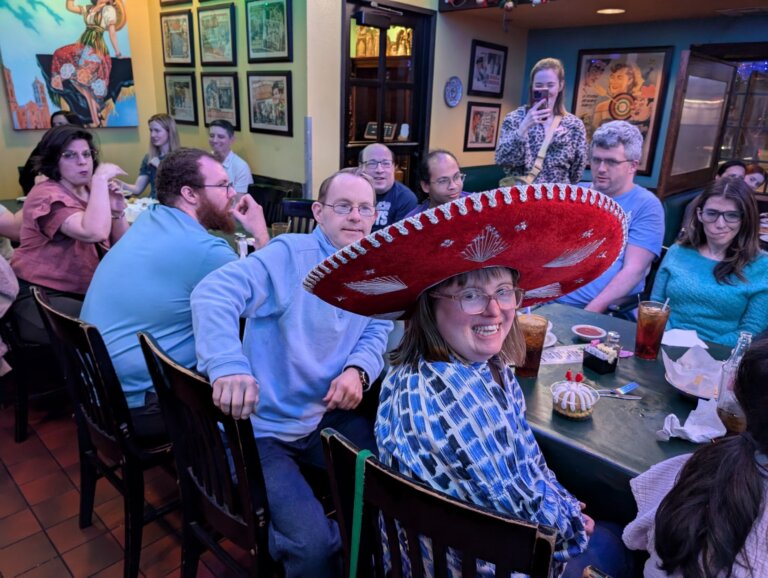
Alana celebrating her birthday with her BOA coworkers.
Alana Drablos, who has Down Syndrome, is one of 85 members of BOA’s Dallas team; Woods says she’s one of the reasons for the team’s success.
“She’s great to work with—everyone loves her—she’s good at what she does, and she’s a great advocate for the disability community,” Woods said.
Alana has been with BOA for more than 13 years, but she’s been part of the workforce for longer. Her first job was with Kroger as a courtesy clerk.
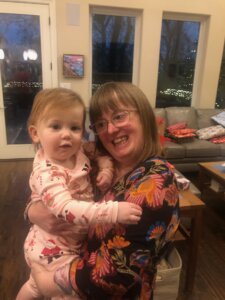
Alana’s mother, Kelly, says her daughter has worked hard to get where she is. She and Alana’s father, Scott, were relentless about keeping her as integrated as possible throughout her education, in addition to getting her the extra attention she needed, such as speech and occupational therapy.
Kelly also gives a lot of credit to companies like Kroger and BOA for creating opportunities that are both good for the company and the person.
“There’s still a lot of resistance to employing people with disabilities,” says Kelly. “BOA’s Support Services unit is big enough to create synergy, and the managers are also very creative in designing tasks that make the most of the unique skills people have.”
Examples to follow
Kelly points to other companies that have figured out how to harness the talent of people with disabilities—historically overlooked and undervalued in the workforce.
“In the warehouse industry, there’s a real push to hire from this group of people,” she said. “There’s an organization called Ken’s Krew, started by Ken Langone of Home Depot, whose purpose is to get companies to hire people with disabilities.”
Like My Possibilities, the local 501(c)(3) that serves adults with IDD, which began as the vision of three mothers, Ken’s Krew was started in 1998 by a group of parents and children with neurodevelopmental disabilities.
“Every organization’s path to workplace disability inclusion is going to be different,” says Woods. “But it starts with a conversation at the top. Do we want to put an emphasis on hiring from the disability community, and if so, what makes sense as a first step for us?”
He says in addition to clear benefits for the organization, people like Alana, who are dedicated, responsible employees, and grateful for the opportunity.
Outside of work, Alana also contributes her time to the Down Syndrome Guild of Dallas. She did a rotation on their board of directors and helps with fundraising activities.
“Each year I help with the Buddy Walk,” says Alana. “I like to be involved and help people out.” She raises money each year and has led a team during several walks.
“She is so dedicated to her job,” says Woods. “She does not want to get sick—she doesn’t want to miss a day. She never wants to be late. She doesn’t get angry.”
Doesn’t everyone want to work with employees like that?
Voices contributing writer Nicole Ward is a data journalist for the Dallas Regional Chamber. This column first appeared on the DRC blog in August 2025.
The Dallas Regional Chamber offers a Disability Inclusion Toolkit. to help companies create a workplace that acknowledges, accepts, and leverages the talents of all people. The toolkit includes data, resources, and best practices, along with stories from experts and people living and working with disabilities.
Don’t miss what’s next. Subscribe to Dallas Innovates.
Track Dallas-Fort Worth’s business and innovation landscape with our curated news in your inbox Tuesday-Thursday.