![Dallas Fort Worth International Airport’s first new terminal in 20 years is breaking records in modular construction with its historic lift of six prefabricated structures. [Photo: DFW Airport]](https://s24806.pcdn.co/wp-content/uploads/2025/08/DFW_Terminal_F_Module_Move_3-970.jpg)
Dallas Fort Worth International Airport’s Terminal F is putting the ‘F’ in its future and footprint.
DFW’s first full terminal build in 20 years—since Terminal D opened in 2005—is now visibly underway, and in a big way. Steel-framed modules nearly the size of a football field are rising on the airfield.
The world’s third-busiest airport says the $4 billion Terminal F construction project is the “largest modular terminal expansion ever undertaken at any airport,” per a recent news release.
But the modules aren’t the only thing that’s scaled up at DFW’s sixth terminal.
Terminal F more than doubled in scope after the airline increased its investment, backed by American Airlines. In May, the plan expanded from a $1.6 billion, 15-gate concept to an estimated $4 billion project featuring 31 gates to be exclusively operated by American.
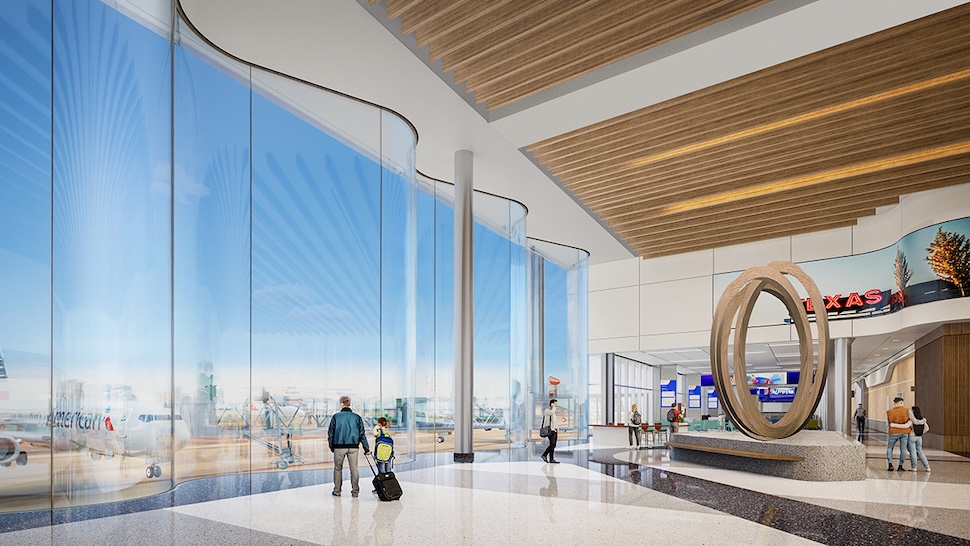
Rendering of interior of DFW Airport Terminal F [Image: American Airlines]
When it’s finished, DFW’s sixth terminal will bring a major boost in capacity for widebody and international flights, along with a fresh slate of amenities and a bigger economic footprint for the region. Phase one, which broke ground in November 2024, is set to open in 2027.
DFW CEO Chris McLaughlin called the progress on Terminal F a sign of the airport’s long-range vision. “This milestone reflects the dedication and vision of the many teams who are building the future of our airport,” he said in a statement.
A big lift, done differently
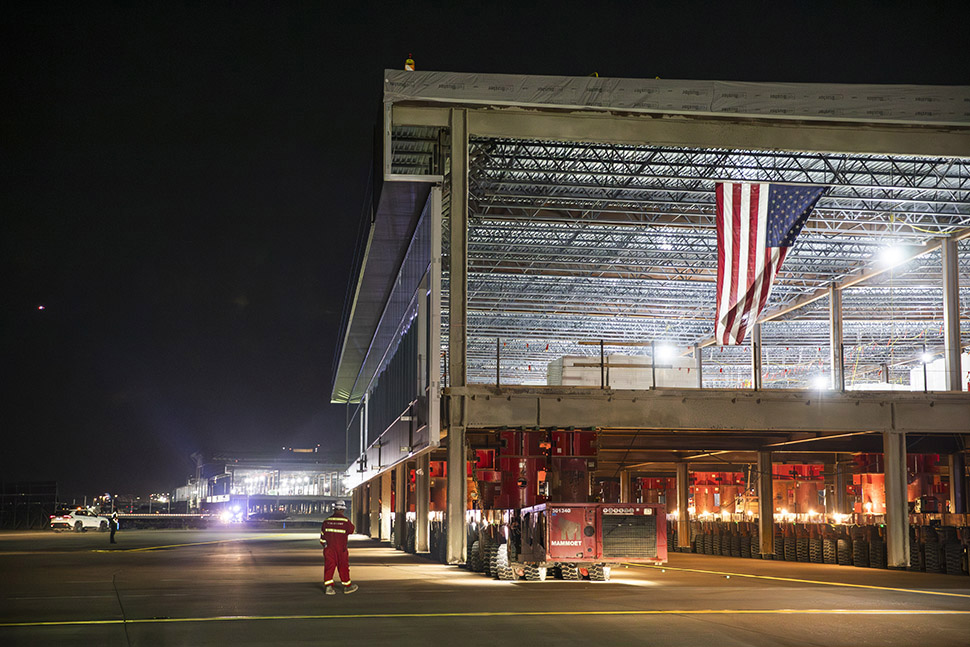
Terminal F, rising. [Photo: DFW Airport]
Dallas Fort Worth International Airport, which serves roughly 90 million passengers each year, recently moved six massive prefabricated building modules into place for the first phase of Terminal F.
Abrar Sheriff, president of Turner Construction Company, called the achievement a “new industry benchmark for precision and efficiency.”
According to DFW, the final module was placed on August 8, capping a two-week sequence of overnight moves. Each structure was assembled offsite, then transported along one of DFW’s airside taxiways via self-propelled modular transporters. The largest module stretched 278 feet long by 136 feet wide and weighed in at 3,320 tons, about the weight of 12 Boeing 787-9 Dreamliners, according to the airport.
“DFW is at the forefront of innovation in terminal construction, continually redefining what’s possible,” said Mohamed Charkas, the airport’s executive vice president of infrastructure and development, in a statement. “The time we save using modular construction techniques is crucial for fostering the growth of our community and supporting our airline partners.”
It’s the third time DFW has used modular construction to reconstruct or expand a terminal, and the latest effort dwarfs previous ones, including modules moved earlier this year for Terminal C. The Terminal F structures are roughly four times larger, the airport said.
The modular technique allows simultaneous work on foundations and offsite construction, speeding up delivery while minimizing disruptions.
Terminal F will expand American Airlines operations
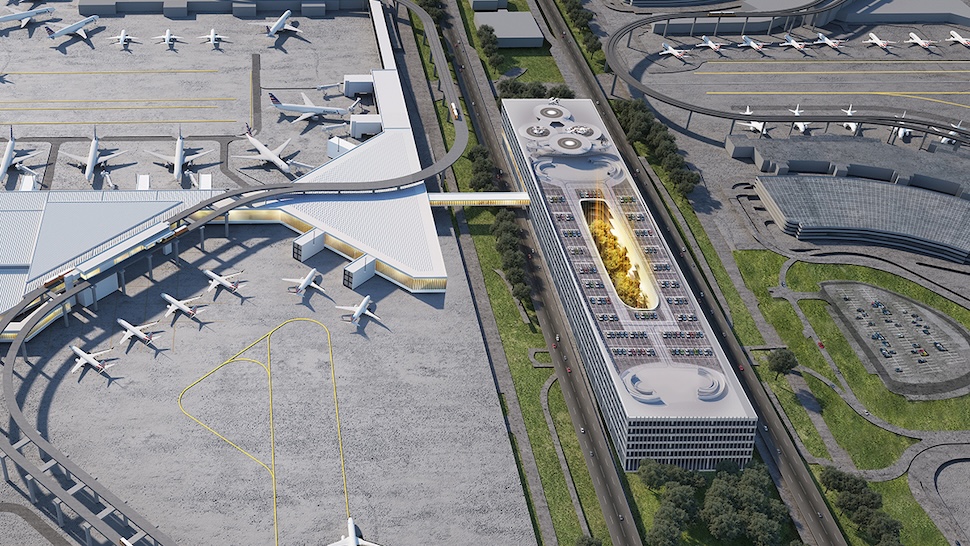
Aerial rendering of DFW Airport’s Terminal F [Image: American Airlines]
The new terminal is being built in partnership with American Airlines, which announced with DFW in May that the project’s scope had expanded and would move faster than originally planned.
The first phase of Terminal F is expected to open in 2027 with 15 gates. At full build out, it will add a total of 31 new gates, designed exclusively for American Airlines. The terminal will include new facilities for ticketing, check-in, security, baggage handling, and parking.
American plans to return gates in other parts of the airport as Terminal F comes online, freeing up capacity for other carriers to grow.
The terminal’s final layout will also include a walking connection to Terminal D and a new centralized Skylink station, DFW said.
A design-build team called Innovation Next+
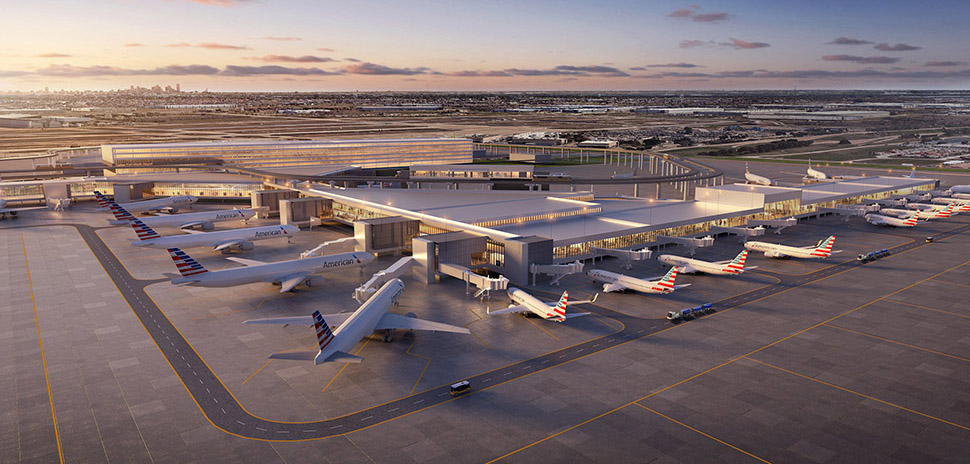
Terminal F [Rendering: DFW Airport]
The airport said the design-build team for the first phase is Innovation Next+, a joint venture of Archer Western Construction, Turner Construction Co., Phillips May Corp., H.J. Russell & Co., and CARCON Industries. The design team includes PGAL, Gensler, and Muller2.
“We are finding smarter ways to deliver results faster, with less impact on travelers,” said DFW CEO McLaughlin.
“Together with our partners, we are delivering infrastructure through innovation and collaboration that will serve the growing needs of North Texas.”
Beyond Terminal F: a $12B plan in motion
Terminal F may be today’s headline project, but it’s just one part of a historic $9 billion capital improvement plan known as DFW Forward. The plan was unveiled in fall 2024 as a multi-year initiative and the largest capital investment in the airport’s history.
Since then, further announcements have detailed expansions and additional investments, including the revised scope for Terminal F, putting the total closer to $12 billion.
With more than 180 projects in various stages of planning and construction, the work is hard to miss in 2025.
Terminal C, one of the five existing terminals, is now undergoing a $3 billion multi-phase reconstruction. The upgrade will bring nine new gates—four more than before—plus expanded seating, modern lounges, dynamic glass windows, higher ceilings, improved restrooms, and a completely refreshed concessions lineup. Adjacent parking garages are also getting rebuilt with smarter tech and more efficient access.
In a nod to DFW’s growing role as a global cargo hub, the airport plans to nearly double its cargo aircraft parking at 19th Street, adding seven new spaces designed for the world’s largest freight planes. And in the skyways, construction is underway on DFW’s third end-around taxiway to streamline aircraft movement and boost safety by reducing runway crossings.
Meanwhile, two new facilities are rising on the airfield to improve emergency response times with reimagined fire stations.
Out front, the airport’s main entrance, International Parkway, is getting a major rework. Crews have installed more than 140 support beams, spanning a total of 2.8 miles, to rebuild bridges and roadways feeding into Terminals A, B, and C for improved traffic flow.
A new east-west connector roadway will also link Rental Car Drive to SH-360 to improve circulation across the airport’s footprint.
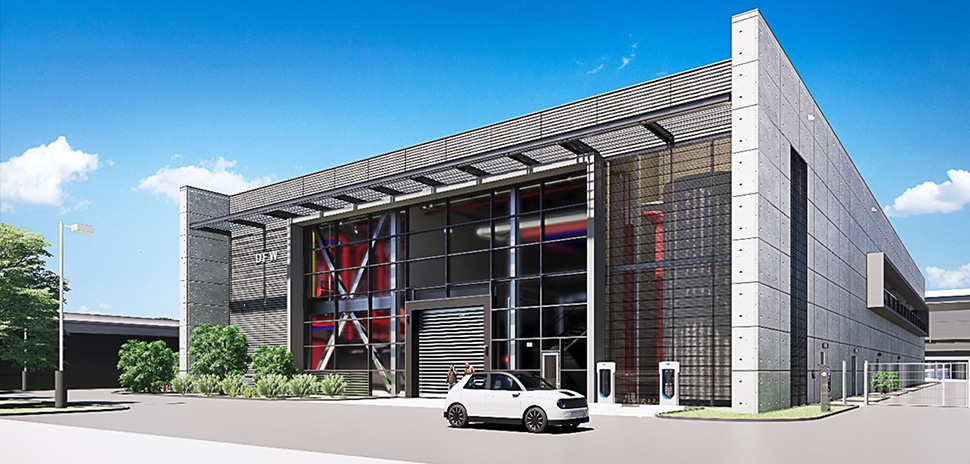
In 2022, DFW Airport announced a $35 million grant from the FAA and the Department of Transportation to build a new zero-carbon central utility plant, or eCUP. [Rendering: DFW Airport]
Elsewhere on the airfield, DFW is doubling down on sustainability. A new Electric Central Utility Plant (eCUP) will heat and cool terminals using advanced power management equipment to efficiently distribute and use purchased renewable electricity.
Dallas Fort Worth International Airport has been recognized as the largest airport in the world to be powered by 100% renewable electricity for its operations.
As North America’s first carbon-neutral airport, DFW says it continues work towards cutting emissions. The airport’s efforts have earned it international recognition, including Level 4+ Carbon Accreditation from Airports Council International. The airport’s new utility plant, expected to open in 2025, will play a major role, DFW said last year.
For construction updates and travel impacts, visit the airport’s project page here.
Lance Murray contributed to this report.
Don’t miss what’s next. Subscribe to Dallas Innovates.
Track Dallas-Fort Worth’s business and innovation landscape with our curated news in your inbox Tuesday-Thursday.
R E A D N E X T
-

North Texas has plenty to see, hear, and watch. Here are our editors' picks. Plus, you'll find more selections to "save the date."
-
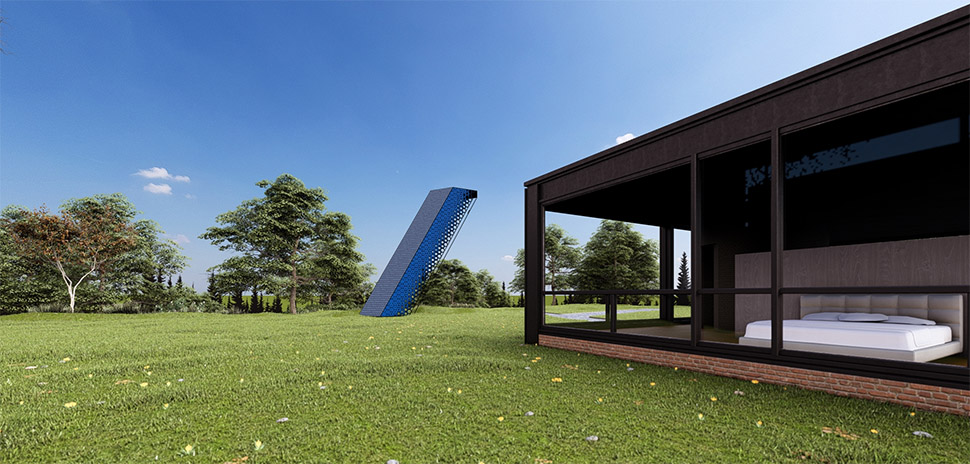
Founder Mohammed Nije grew up without electricity. Now his Dallas startup, Janta Power, is piloting his power-dense solar technology at DFW and airports worldwide—earning global recognition for a design he says uses less land, generates more power, and can lower energy costs.
-

Dozens of sessions. Four signature summits. Hundreds of speakers. DFW Startup Week 2025 kicks off next week, and here’s how to make the most of it.
-

No, those 2,500 people running at DFW Airport on October 5 won't be late for their flight. They'll be taking over a runway to help celebrate the 50th anniversary of the third-busiest airport on earth.
-
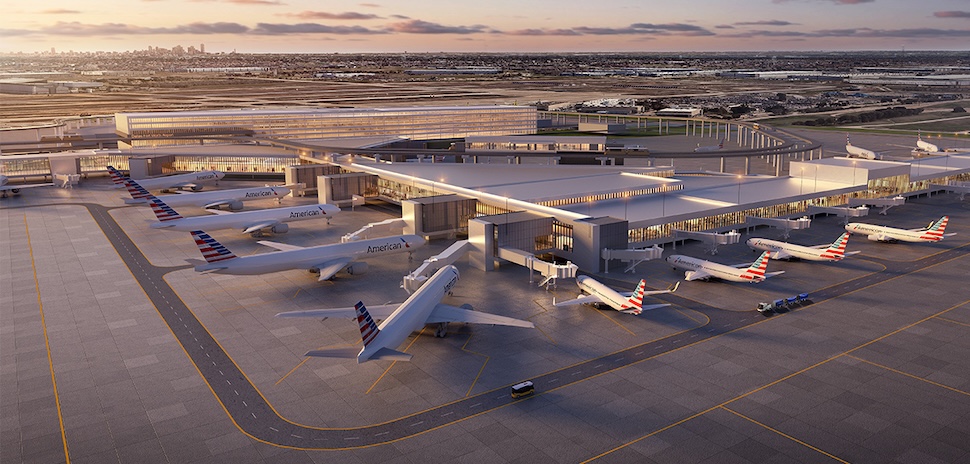
American Airlines and Dallas Fort Worth International Airport unveiled plans Thursday for the airport's sixth terminal—Terminal F—that will enable both to "continue growing together." American and DFW have increased the planned investment in Terminal F to around $4 billion—aiming to create what will be DFW’s "signature terminal experience," operated entirely by American Airlines.