Four weeks of live-fire exercises just gave the U.S. Army a glimpse of the future battlefield—proving that lasers could play a key role in protecting U.S. troops for decades to come. And the system everyone was watching was made right here in North Texas.
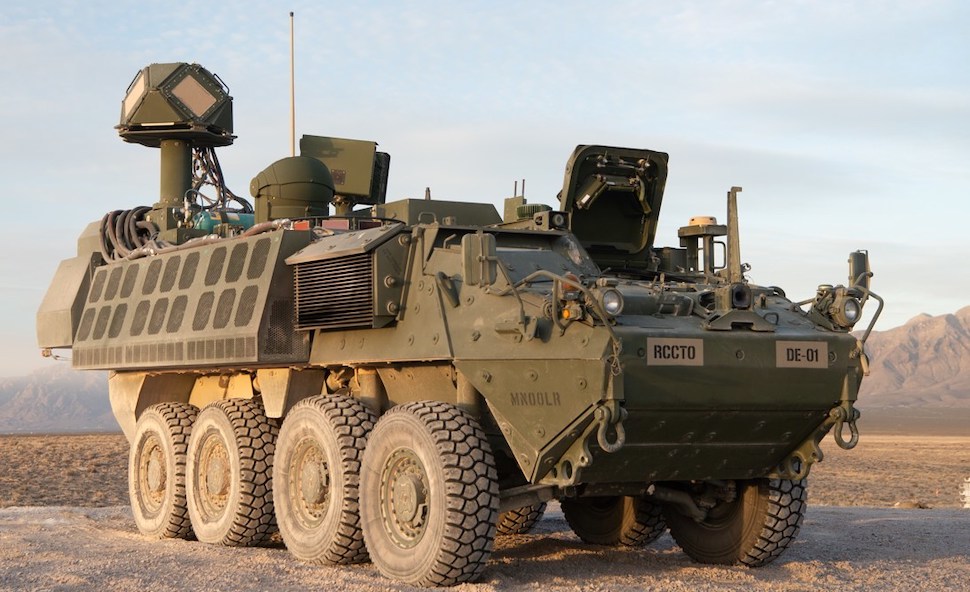
A high-energy laser weapon built at Raytheon’s Intelligence & Space campus in McKinney was recently tested by the Army at the White Sands Missile Range in New Mexico. Mounted on a Stryker armored fighting vehicle, the 50kW-class directed energy weapon system successfully acquired, tracked, targeted, and defeated multiple live-fire 60mm mortar rounds.
The laser system also accomplished multiple test simulations of real-world scenarios, Raytheon says—including shooting down small, medium, and large drones.
On track for operational fielding this year
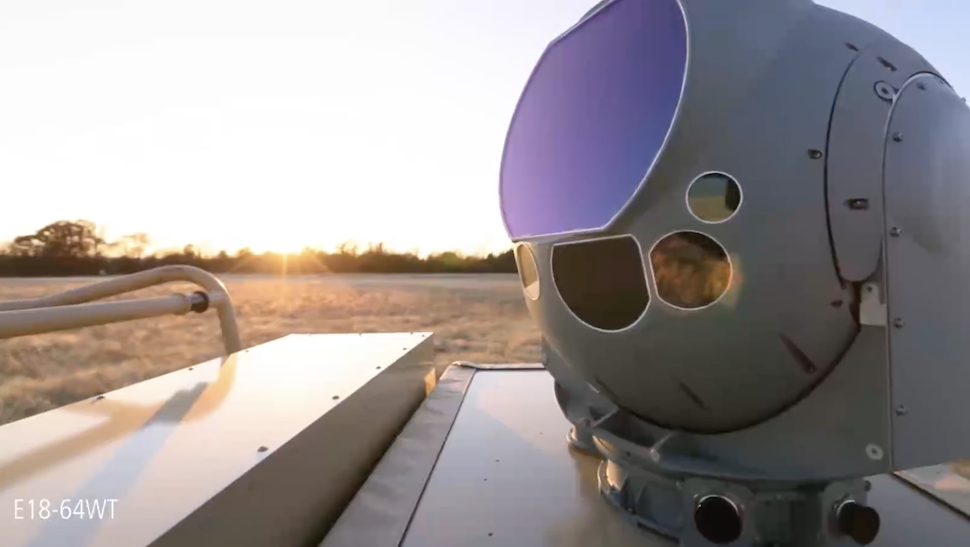
Raytheon’s high-energy laser weapons system. [Video still: Raytheon]
This isn’t a far-off futuristic weapon for “someday” use—the system is already on track for operational fielding in 2022. The joint industry team, which includes Rocky Research for power and thermal management, General Dynamics Land Systems for the Stryker platform, and Applied Technology Associates for additional sensors, is slated to deliver four DE M-SHORAD units to Army brigade combat teams later this year, Raytheon says..
The combat-capable weapon system is part of the Army’s Directed Energy Maneuver-Short Range Air Defense, or DE M-SHORAD. An industry team led by Raytheon Intelligence & Space and Kord—a wholly owned subsidiary of KBR—was responsible for the recent White Sands tests.
‘A new level of protection’

Annabel Flores, president of Electronic Warfare Systems for Raytheon Intelligence & Space. [Photo: Raytheon]
“Soldiers in the field face increasingly complex threats, and our combat-proven sensors, software, and lasers are ready to give them a new level of protection,” said Annabel Flores, president of Electronic Warfare Systems for Raytheon Intelligence & Space, in a statement. “The Army gave us our toughest challenge yet—countering rockets, artillery, and mortars—and we took an essential step on the path to providing the maneuverable, short-range air defense soldiers need.”
The DE M-SHORAD effort aims to protect soldiers against numerous aerial threats, including unmanned drones, rotary-wing aircraft, rockets, artillery, and mortars. Raytheon I&S provides the high-energy laser weapon module, a specialized radar acquisition system, a beam control system, and targeting sensor. Kord’s role is integrating the system on the Stryker combat vehicle.
‘Infinite magazine’ and ‘near-zero cost per shot’
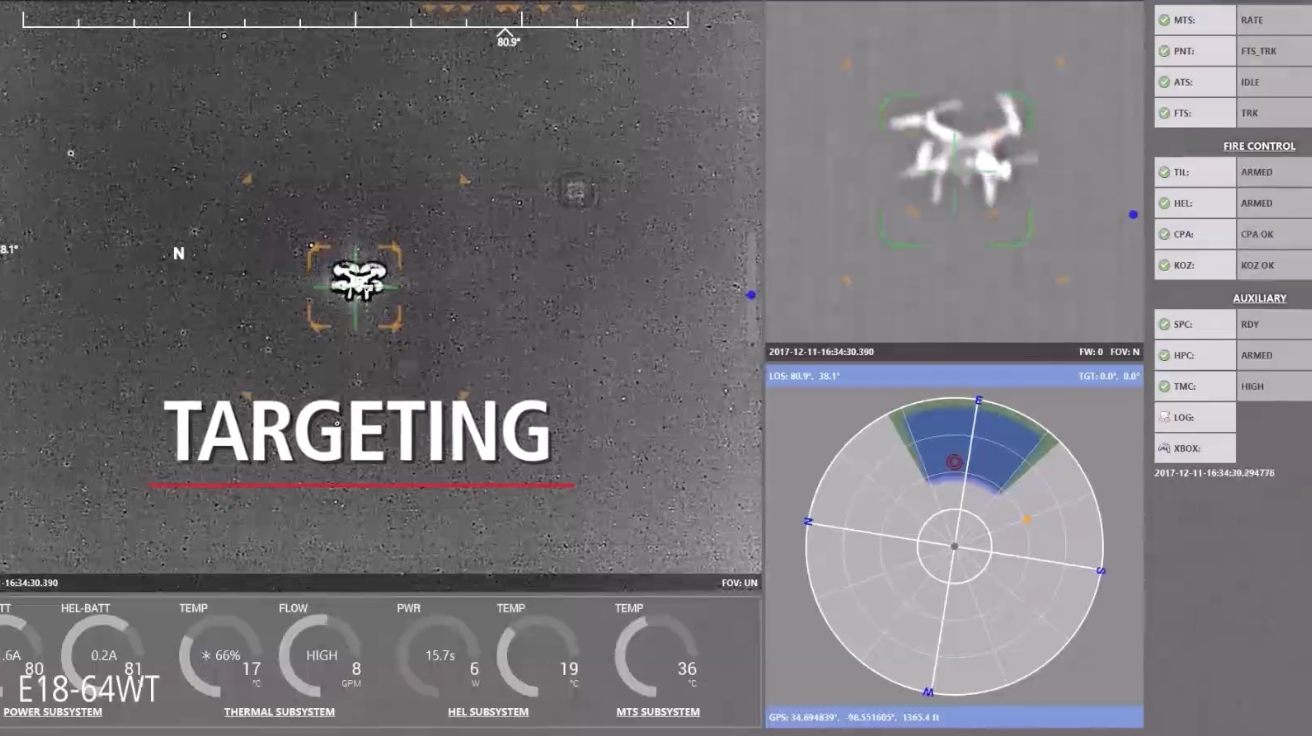
Raytheon’s laser weapon targeting system. [Video still: Raytheon]
One of the biggest benefits of a laser system? You don’t run out of ammo, because the “magazine” is virtually infinite, said Byron Bright, president of KBR Government Solutions.
“This team once again showed that the HEL system is fully integrated and ready to provide protection against complex threats,” Bright said in the statement. “With an effectively infinite magazine and near-zero cost per shot, HEL is now the proven answer to asymmetric threats like drones and mortars.”
Raytheon laser systems work on land, in air, and at sea
The high-energy laser (HEL) weapon systems from Raytheon I&S are built in McKinney and are able to work on land, in the air, and at sea. Their 360-degree coverage can protect military bases and airports as well as civilian sports stadiums and other potential targets of “asymmetrical warfare.”
The systems feature open architecture, scalable power, and “ruggedized design” for a variety of mission demands. Major suppliers for the system are based in Huntsville, Alabama; Albuquerque, New Mexico; Portland, Oregon; East Granby, Connecticut; and Los Angeles, California, Raytheon says.
RELATED STORIES
Raytheon Intelligence & Space Opens a New Intelligent Manufacturing Center at Its McKinney Campus
Raytheon Intelligence and Space Chief Engineer Motivated by Supporting U.S. Military

Get on the list.
Dallas Innovates, every day.
Sign up to keep your eye on what’s new and next in Dallas-Fort Worth, every day.
R E A D N E X T
-

HBCU HUB, a startup focused on connecting students to recruiters at historically Black colleges and universities, is moving its headquarters to McKinney with the aid of grant funding from the McKinney Economic Development Corporation’s Innovation Fund.
-

The 178,000-square-foot facility is a result of a $100 million investment and collaboration with the McKinney Economic Development Corporation—which included an already-complete commitment to generate 500 skilled jobs. RI&S plans to build an even larger facility by 2025 that will generate 700 more jobs.
-

The EdTech marketplace and PaaS startup will expand its HQ with a grant from the McKinney Economic Development Corporation's (MEDC) Innovation Fund. The startup connects learning resource buyers and sellers in 7,000 languages and dialects. The woman-owned and minority-led company says it's "empowering micro-entrepreneurs to reach their customers globally."
-
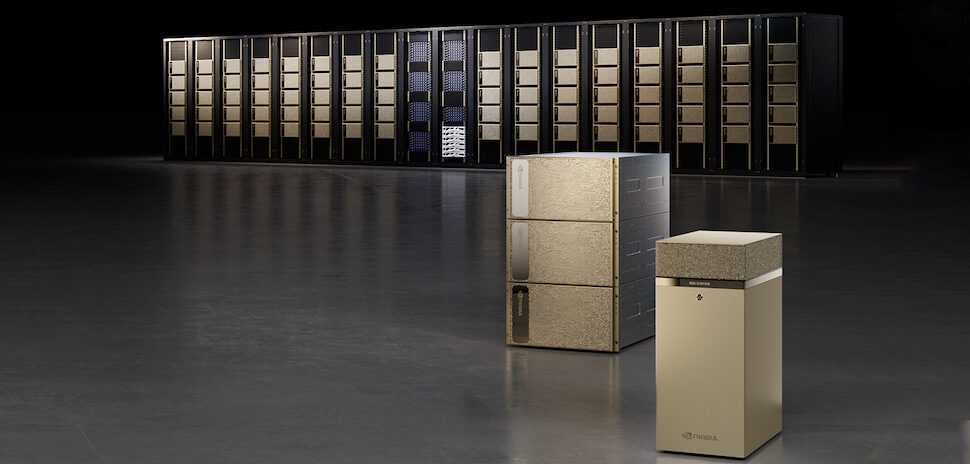
SMU is investing $11.5 million into a powerful new supercomputing research system featuring an NVIDIA DGX SuperPOD. Connected with the NVIDIA Quantum InfiniBand networking platform in SMU's data center, it will produce a theoretical 100 petaflops of computing power—enabling the university's network to perform "a blistering 100 quadrillion operations per second." The new capability will supercharge SMU's AI and supercomputing exploration, boosting North Texas' growth as a technology hub.
-

Produced at Raytheon's campus in McKinney, north of Dallas, the RAIVEN Staring system delivers a next-gen “electro-optical intelligent-sensing” capability that can identify threats both optically and spectrally simultaneously in real-time—creating greater situational awareness and survivability for military pilots conducting combat missions.