Denton ISD opened three new elementary schools in 12 months, each built around an “active hub” design that rethinks the traditional hallway-and-classroom model.
Martinez Elementary opened in August 2024, followed by Hill Elementary and Reeves Elementary in August 2025. Each school spans 113,500 square feet with a capacity for 750 students.
The three schools share a common layout, but each responds to its site and community with a color palette that echoes its feeder high school to reinforce identity and connection, Pfluger said.
Each campus honors a longtime Denton ISD educator: Anita Reeves taught in the district for 35 years; Fred Hill was the first African American man to serve on the district’s Board of School Trustees; and Dorothy Martinez was a longtime teacher and board member.
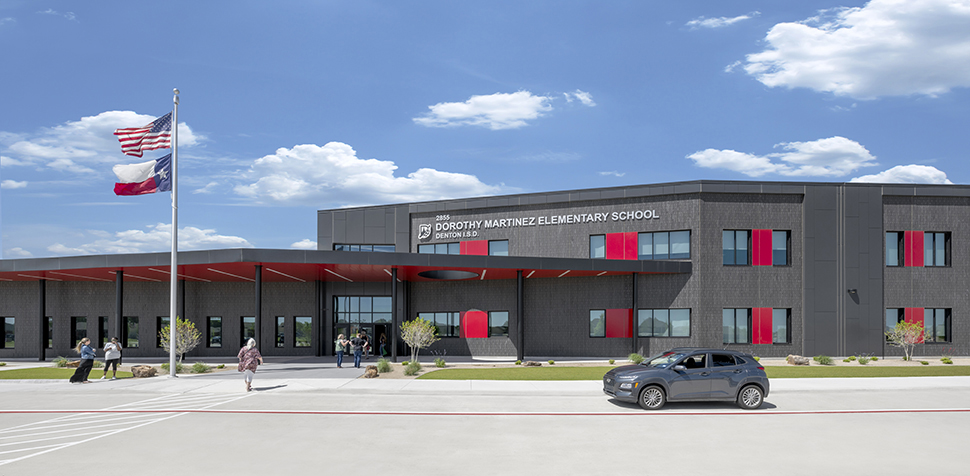
The exterior of Martinez Elementary ties into the school colors—red, black and gold—for the Martinez Monarchs. [Image: Wade Griffith/Pfluger Architects]
Rethinking “how students learn and teachers teach”
“The district was ready to rethink how students learn and teachers teach, with the whole school an active, fully connected neighborhood,” said Christian Owens, principal design director at Texas-based Pfluger Architects, in an announcement.
Pfluger Architects partnered with the Denton school district on a prototype two-story design, which centers around a shared hub that merges the library, dining commons, and courtyard into one open, active core, he said. Classrooms and programs extend from this space to create clear sightlines and encourage movement between learning areas.
The new model increases educational space by 28% while reducing exterior access points and the building footprint overall, according to the firm, which has an office in Dallas’ West End.
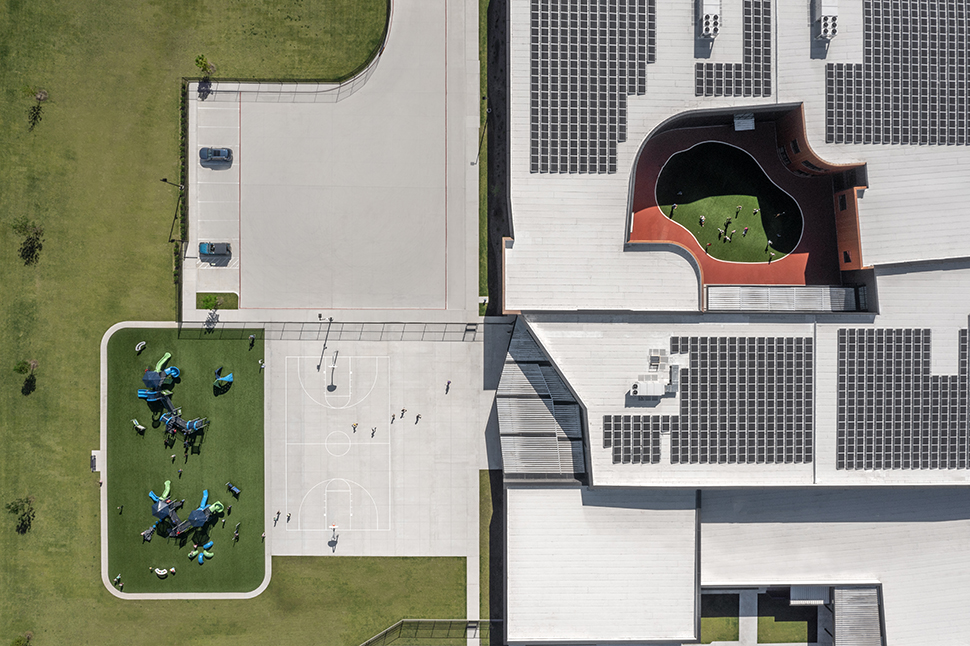
From above, Martinez Elementary’s hub-centered prototype shows a curving courtyard at the building’s core, rooftop solar arrays, and adjacent playgrounds and courts. [Image: Wade Griffith/Pfluger Architects]
Meeting fast growth with fast build
Denton ISD, which expects 4,000 new students over the next five years, sits in one of the nation’s fastest-growing counties, Pfluger said, citing U.S. Census data. In 2023, voters approved a capital improvement plan that required opening one school within a year of bond passage.
That timeline set the pace for the project, while a collaborative visioning process set the tone for a redefined elementary model.
Rather than replicate the old model, the district launched a visioning process grounded in learner needs, staff input, and community priorities, Pfluger said.
Martinez and Hill elementary schools were built using prefabricated wall panels. While grading began on-site, panels were fabricated off-site and installed after foundations were set. The approach minimized on-site labor, enhanced envelope quality, and sped the drying-in process, according to Pfluger.
Balfour Beatty was the general contractor for all three campuses.
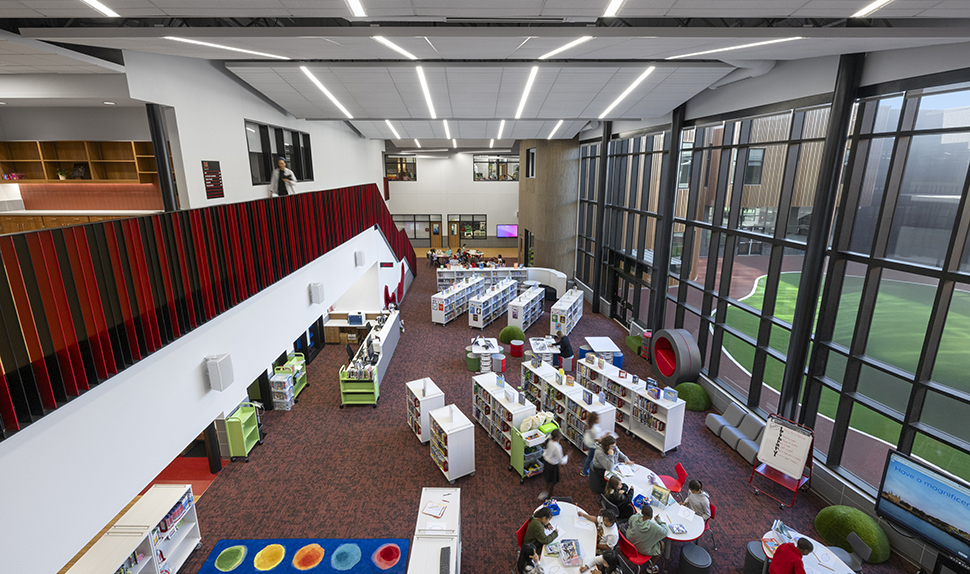
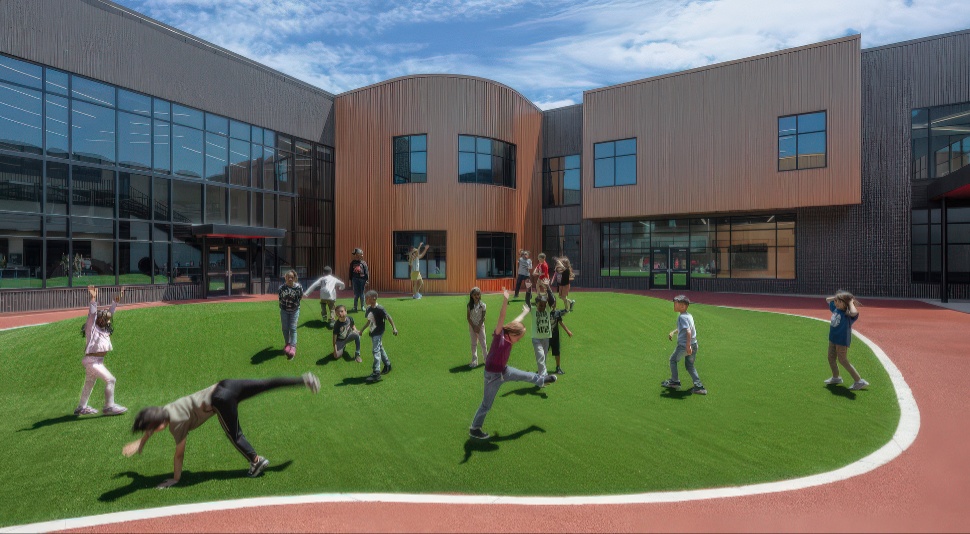
Inside the hub at Martinez Elementary, the library/media center opens to an outdoor learning courtyard. Two-story glazing and upper-level sightlines support visibility, supervision, and collaboration. [Image: Wade Griffith/Pfluger Architects]
Hub design supports flexibility
The prototype model centers daily learning around the active hub, allowing grade levels to flex around the core as enrollment shifts, Pfluger said. Classrooms, collaboration zones, and outdoor areas are physically and visually linked to enable passive supervision without disruption. Intervention pods, calming rooms, and shared collaboration areas can also adapt to daily needs.
Learning space is maximized and outdoor views support wellness and learning, Pfluger said.
“As we designed these buildings, we thought about learning on display and how we ensure everywhere we go in every part of the building, there’s an opportunity to see learning, to participate in learning, and to collaborate,” Denton ISD Superintendent Susannah Holbert O’Bara said in the announcement. “Students and teachers benefit from flexible spaces that encourage autonomy, teamwork, and interaction across programs.”
She added that the model is transparent and scalable as the community grows.
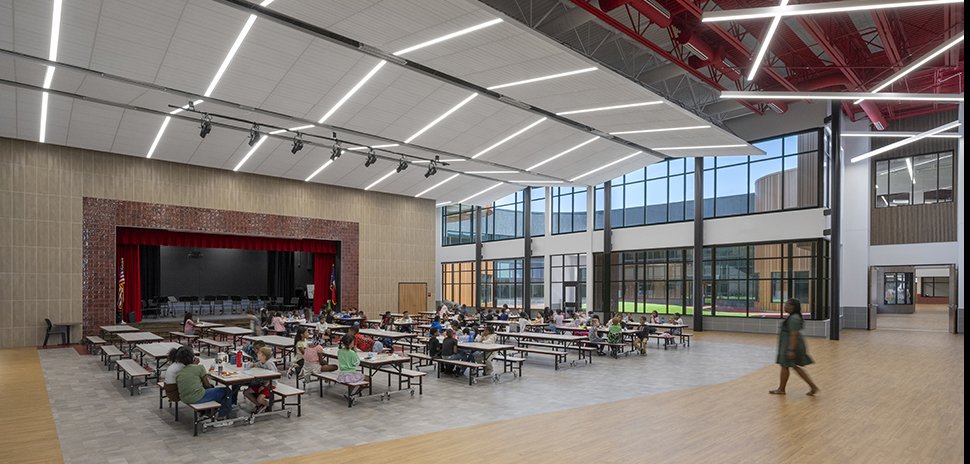
The dining commons includes an integrated stage for performances and assemblies, with an open layout that links to adjacent learning areas along the hub. [Image: Wade Griffith/Pfluger Architects]
Energy performance brings tax credits
Pfluger and CMTA performance engineers designed the schools for long-term performance. The focus on educational goals was paired with the need for efficient systems that reduce energy use, improve air quality, and lower costs, Pfluger said.
The three schools target an energy use intensity of 20 or lower, with Martinez tracking at 18 EUI, the firm noted.
Martinez and Hill together are expected to earn $4.2 million in tax credits that will support future capital investments. The energy usage performance qualifies the district for Clean Energy Tax Credits through Elective Pay, according to the announcement.
More views
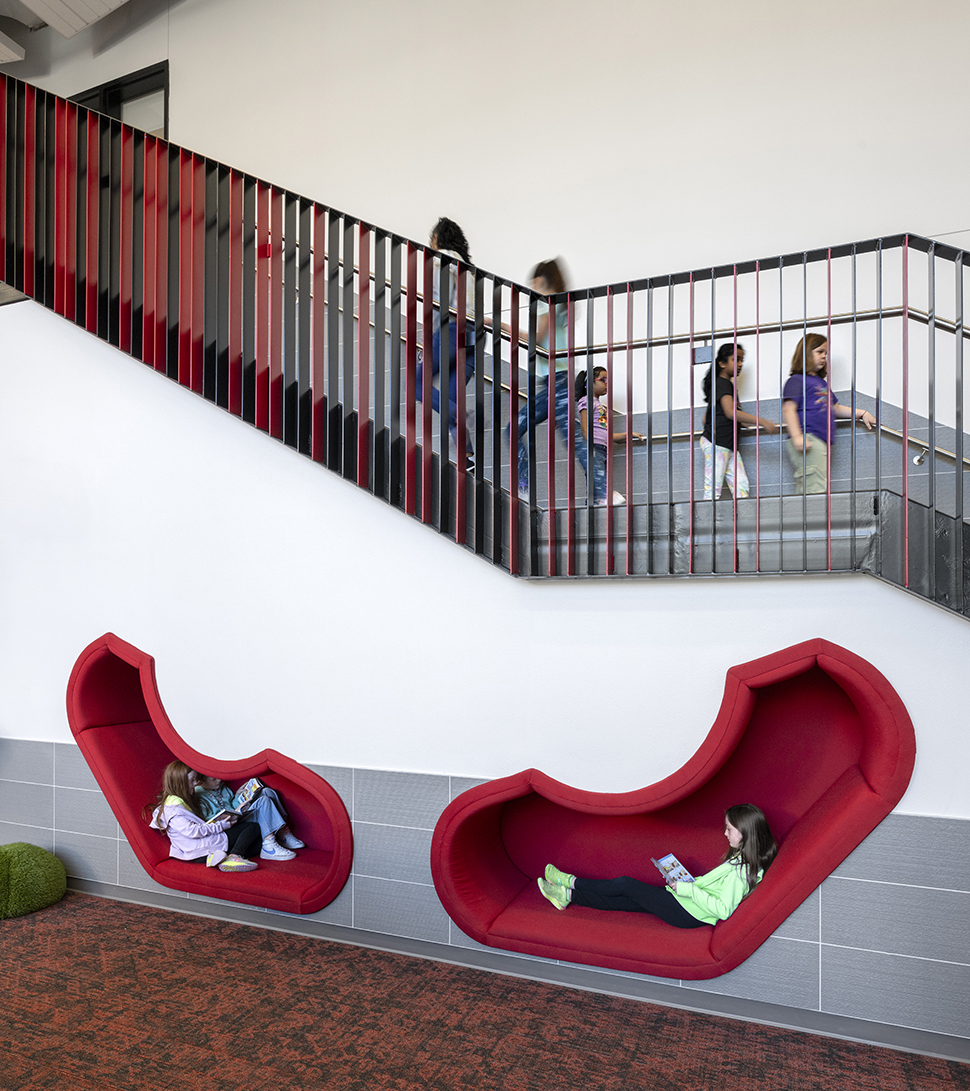
Under the main stair, built-in reading nooks give students quiet spots for independent reading, with red accents echoing the Martinez Monarchs’ colors. [Image: Wade Griffith/Pfluger Architects]
Don’t miss what’s next. Subscribe to Dallas Innovates.
Track Dallas-Fort Worth’s business and innovation landscape with our curated news in your inbox Tuesday-Thursday.
R E A D N E X T
-

Cait Brumme says the event at Dallas' Pegasus Park on Nov. 6 will explore the technologies and economic forces defining the future for entrepreneurs and innovators.
-
The new center at Bridge Labs will train the workforce powering North Texas’ biotech boom—helping startups speed therapies, vaccines, and breakthrough biologics from lab bench to patients. Funded in part by Lyda Hill Philanthropies, the National Center for Therapeutics Manufacturing Satellite Campus is set to open this summer.
-
The study of data from past storms includes researchers from multiple universities as well as international partners from hurricane-prone regions including the Bahamas, Jamaica, and Costa Rica.
-

You'll find deadlines coming up for a new accelerator program; and many more opportunities.
-

AI seem overwhelming? Just go to office hours.