MORE►
UT Dallas

[Sources: suksunt sansawast/Kolonko/arthobbit/istockphoto; DI Studio]
North Texas’ EnLiSense Develops Wearable Sensor That Uses Sweat to Track Sleep Hormones
by Maddie Preston | Feb 3, 2026
A UT Dallas study supports Allen-based EnLiSense’s approach to circadian health monitoring, via a wearable that directly measures biochemical markers tied to wakefulness and sleep.

by Maddie Preston |
Dec 29, 2025
A five-year NSF award to the Center for Wind Energy Science, Technology, and Research supports new work using AI to reduce turbine defects, improve reliability, and strengthen the U.S. energy grid.
MORE►
by Maddie Preston |
Dec 15, 2025
TAMEST — the Texas Academy of Medicine, Engineering, Science & Technology — named five statewide recipients for its 2026 Edith and Peter O’Donnell Awards, including three from Dallas-Fort Worth institutions. The honorees will be recognized in February, with nominations for 2027 opening in January.
MORE►

by Maddie Preston |
Dec 10, 2025
After opening its Americas HQ in Plano earlier this year, Tech Mahindra is now launching its first U.S. Makers Lab at its Plano facility through a new applied AI partnership with UT Dallas.
MORE►


[Image: ADragan/istockphoto]
CPRIT Awards Grants to 15 Dallas-Fort Worth Researchers in Latest Funding Round
by Dallas Innovates | Staff Report | Dec 5, 2025
The Cancer Prevention & Research Institute of Texas offers funding opportunities for promising cancer research, product development, and prevention programs. The state-funded initiative stands as the second-largest public backer of cancer research in the U.S. after the National Cancer Institute.
MORE►

by Maddie Preston |
Nov 24, 2025
The brain-inspired design could lower the energy and compute costs behind AI training requirements, an increasingly urgent challenge for enterprises.
MORE►
by Maddie Preston |
Sep 27, 2025
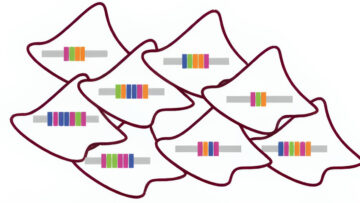
The UTD team’s approach adapts a chip-security technique to biology. The breakthrough gives biotech companies a new way to prevent costly misidentification and protect intellectual property.
MORE►
by Quincy Preston |
Sep 3, 2025
The new federal Alzheimer's hub joins an elite network of 37 centers nationwide. Scientists from UT Southwestern, UT Arlington, and UT Dallas will decode dementia by exploring hypertension's role, analyzing voice patterns with AI, and creating virtual patient models.
MORE►

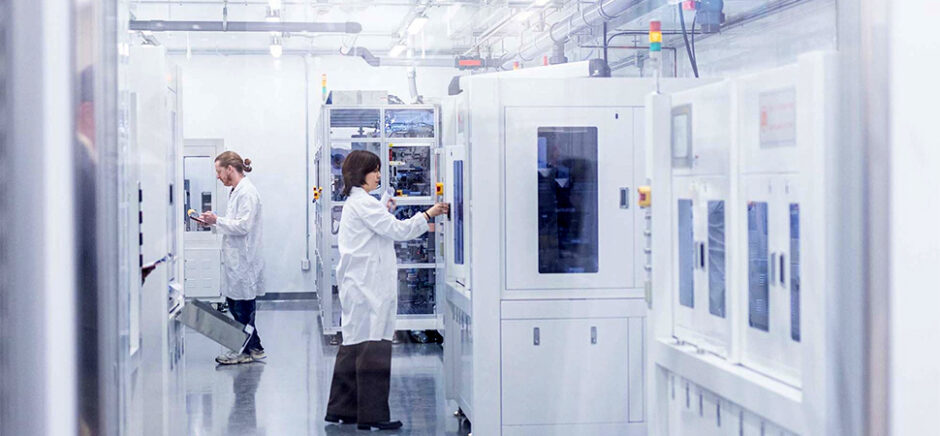
Lab assistants work in the cell assembly room at UT Dallas’ BEACONS facility, where specialized features support the assembly of solid-state and other advanced battery chemistries. [Photo: UT Dallas]
Inside BEACONS: UT Dallas’ New Pentagon-Backed Hub for U.S. Battery Technology
by Quincy Preston and Lance Murray | Jul 22, 2025
Backed by the Department of Defense and $200 million in private capital, the new facility helps companies prototype and scale battery technologies for both commercial use and national defense. The launch comes at a time when supply chain independence is a growing priority.
Government and industry leaders recently got a first look.
MORE►
by Lance Murray |
Jul 1, 2025
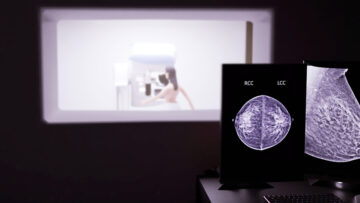
Rather than replace radiologists, UTD researchers say AI could help flag low-risk mammograms for automated review. The approach could cut costs and ease delays as cancer rates rise and the diagnostic workforce shrinks.
MORE►
by Lance Murray |
Jun 20, 2025
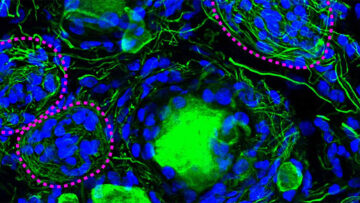
A scientific footnote from 1922 is now a potential key to treating diabetic nerve pain, a chronic and widespread condition with few effective options. The new study wouldn't have happened without the nonprofit Southwest Transplant Alliance, says UT Dallas neuroscientist Ted Price, who credits the group with making the research possible.
MORE►
by Lance Murray |
Jun 17, 2025
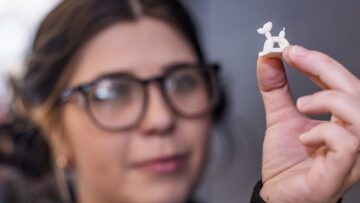
The lightweight, recyclable material can be printed into complex shapes—including a balloon dog—and shows potential for use in helmets, insulation, and more. The research explores a method still largely untapped in commercial manufacturing.
MORE►

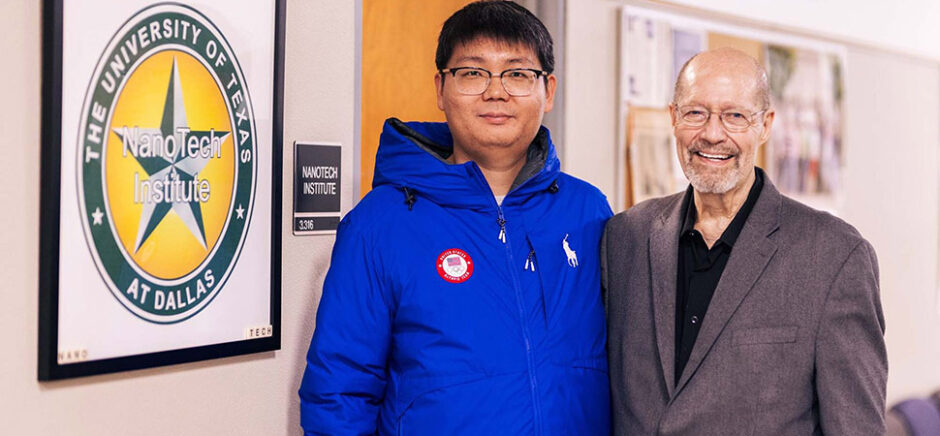
Mengmeng Zhang, left, a research scientist at UT Dallas’ NanoTech Institute and lead author of the study, wears a U.S. Olympic team jacket embedded with artificial muscles created using an earlier, mandrel-wrapped process. At right is Ray Baughman, director of the NanoTech Institute. [Photo: UTD]
UT Dallas Researchers Create Low-Cost ‘Artificial Muscles’ That Could Power the Future of Smart Clothing and Robotics
by Lance Murray | Jun 11, 2025
An earlier version of the technology was used in jackets worn by U.S. Olympic athletes in 2022. A new fabrication technique could make large-scale production feasible for adaptive clothing to self-powered sensors and wearable tech.
MORE►

by Lance Murray |
Jun 4, 2025
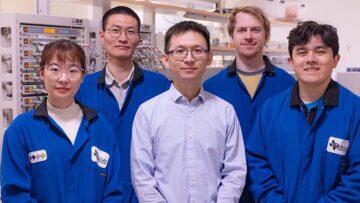
The UT Dallas team found that mixing small particles between two solid electrolytes can generate an effect called a “space charge layer"—an accumulation of electric charge at the interface between the two materials, making it easier for ions to move across the interface.
MORE►

by Lance Murray |
May 8, 2025
If appointed by regents after the state-required 21-day waiting period for sole finalists, Rutgers University's Prabhas Moghe would succeed Richard Benson, who announced in August his plan to transition back to a faculty role at UTD.
MORE►
by David Seeley |
May 6, 2025
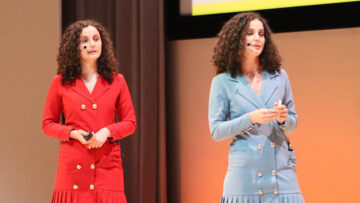
Ikeda and Orikeda Trashi took home $12,000 in the Big Idea student competition for Biodelivera, a platform that delivers cancer therapy directly to tumors. In the alumni track, the top prize went to Brice Sokolowski for his sweat-evaporating Vaucluse Backpack Ventilation Gear.
MORE►