From finding ways to reduce packaging waste and improve customer experience, to adopting eco-friendly farming practices that support a stronger food chain, to learning how to cut energy use and lower costs—sustainability offers benefits across every industry. Even better when it’s good for the planet and the balance sheet.
According to McKinsey & Company, initiatives that improve efficiency across energy, water, waste, and raw materials can significantly boost financial performance, reducing costs and increasing operating profits by as much as 60%.
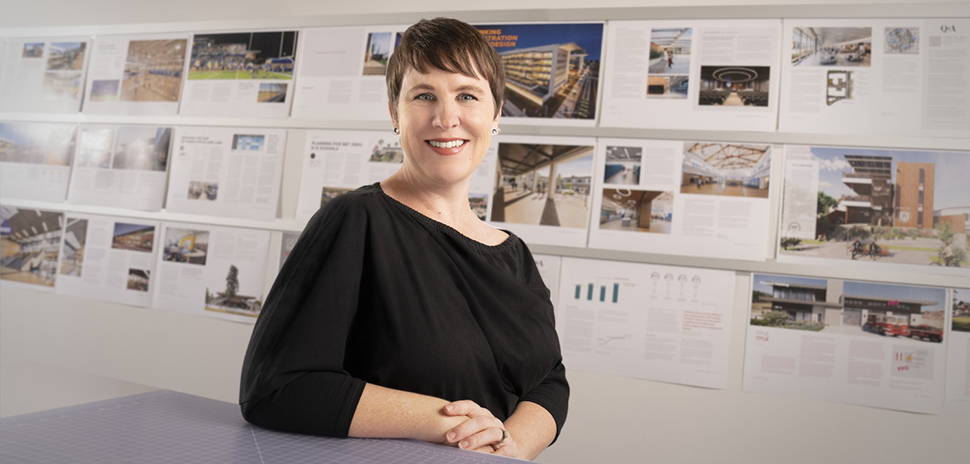
“We’re fortunate in Texas when it comes to energy consumption—we have lower rates compared to the rest of the nation,” said Ellen Mitchell, director of sustainability and applied research at architecture firm LPA Design Studios. “With the grid problems we’re having and energy prices increasing in the last few years, clients are thinking in new ways about resilience and energy independence.”
Mitchell says that regardless of a client’s views on the environment, every business is looking for ways to impact the bottom line. That’s why LPA, which counts school districts, biotech companies, and the Dallas Public Library as clients, ties every design decision back to client value. Whether concerned about energy cost, employee health, community cohesion, or competitive advantage, LPA believes you can get there faster, cheaper, and better with high-performance design.
“You can say ‘sustainable’ or ‘high-performance.’ They’re the same thing: buildings that do more with less,” Mitchell said. “That’s fundamentally economical.”

Designed to ‘gamify’ sustainable design discussions and help establish a shared vocabulary around performance, wellness community, and experience.
The sustainability roller coaster
On the walls of LPA’s historic West End design studio, a site plan for a new life sciences corridor in DeSoto epitomizes the firm’s value-driven approach to sustainability.
The design describes not just high-efficiency buildings, but a “life science community embedded within a conservation garden”—a biodiverse, storm-resilient landscape that leverages five branching ‘finger parks’ to connect the surrounding neighborhoods. At the heart of the project are the client’s goals: healthy employees, vibrant public spaces, a place where creative collisions drive innovation. Environmentally friendly design is just how LPA gets there.
Projects like this are why LPA, with seven locations in total and three in Texas, just received a prestigious 2025 Firm Award from the American Institute of Architects (AIA), considered the “Academy Award of Architecture.” The award often goes to “star-chitects”—famous, personality-driven firms such as I.M. Pei—but this year, LPA earned it “for establishing itself as a trailblazer in sustainable, high-performance architecture,” according to the AIA announcement. Doing ordinary projects for ordinary clients is how LPA earned its reputation for designing sustainably regardless of budget, scale, or scope.
Mitchell says their win may signify another sea change, as the architecture broadens the definition of award-winning design.
“Cutting energy use really took off after the oil embargo in the 1970s. But then the trend changed, and everyone wanted to design glass boxes that were hermetically sealed and completely dependent on air conditioning,” Mitchell said.

The first library to use the state’s new One Water framework for water conservation, LPA’s expansion of Wimberley Village Library highlights an integrated rainwater collection system, starting an important community conversation about drought, flooding, and resilience. [Photo: Matthew Niemann]
She said by the turn of the century, people were again interested in doing well and doing good, and the LEED rating system was gaining traction. LEED—Leadership in Energy and Environmental Design—was formally launched in 2000 by the U.S. Green Building Council. It evaluates buildings for water efficiency, energy and atmosphere, and materials and resources, using a point-based rating system that ranges from 40 points (certified) to 80 or more (platinum).
Starting before the beginning
For LPA, before plans can be drawn up, the team does a lot of talking and even more listening to nail down what clients are really trying to solve for.
“Clients and architects speak different languages. We might say ‘heat island effect.’ They say, ‘The playgrounds are too hot,’ but we’re saying the same thing,” Mitchell said.
The Goal Setting Card Deck—a product of Mitchell’s Sustainability and Applied Research team that won LPA Fast Company’s 2024 Best Workplaces for Innovators award—provides a common language. It’s divided into Performance, Community, Wellness, and Experience—all of which tie directly to sustainability.
Mitchell said this part of the process is critical because the most expensive way organizations can build is by thinking they can address sustainability as an add-on. In other words, taking a business-as-usual approach to design and then adding a bunch of solar panels on the roof.
“Solar is definitely one piece of the sustainability cake, but people should think of it as the icing. With only passive measures, we can still reduce energy use somewhere in the ballpark of 70%,” Mitchell said.

LPA has built a niche in office-to-lab conversions. For Fulgent Genetics, designers transformed a call center in Coppell into a fully functioning anatomical pathology lab in just eight months. [Photo: Fulgent Genetics/Sean Gallagher Photography]
Charting success
While buildings account for an estimated 40% of greenhouse gas emissions, anything that makes a project more expensive is a losing proposition. But instead of pushing an agenda, LPA works to find sustainable solutions that will pay off over time—keeping money in their clients’ pockets.
“We track energy performance across all of our projects, and in aggregate, our designs reduce energy consumption 20% to 30% more than competitor firms doing the same work,” Mitchell said.
After 13 years of tracking energy performance on every project, LPA finds that it outpaces the industry, with a five-year average of 75% energy use reduction—a good sign as it pushes toward its 2030 goal of a portfolio without carbon emissions.

LPA for Change is providing pro-bono design services for a health clinic in Joppa; the design emphasizes wellness-focused sustainability.
Voices contributor Nicole Ward is a data journalist for the Dallas Regional Chamber.
Don’t miss what’s next. Subscribe to Dallas Innovates.
Track Dallas-Fort Worth’s business and innovation landscape with our curated news in your inbox Tuesday-Thursday.
R E A D N E X T
-

North Texas has plenty to see, hear, and watch. Here are our editors' picks. Plus, you'll find more selections to "save the date."
-

The BMW Dallas Marathon is gearing up for its 2025 race weekend, to be held in a long, winding course around White Rock Lake December 12–14. One way it's doing that is by unveiling "a bold new logo" featuring a modern take on the Pegasus—Dallas' celebrated icon—stretching its neck out toward victory. Along with a refreshed merchandise collection, the updated visual identity "reflects the organization’s evolution as a premier running event and its deep connection to the Dallas community," organizers said.
-

UT Dallas researcher Dr. Walter Voit transformed Minecraft’s 170-million-player universe into an advanced virtual training ground—for students and for AI agents tested by DARPA. His team’s Polycraft World uses gameplay to turn classroom theory into real-world expertise, covering topics from synthetic organic chemistry to nuclear plants to semiconductor facilities. Their new startup company, Pedegree Studios, has licensed the core technologies from the university to create a scalable digital pipeline for education and workforce development.
-

Combining cutting-edge research and real-world applications, the UT Dallas professor transforms public health with innovations in detection technology, including “a check engine light” for the human body. In collaboration with EnLiSense, the company she cofounded, Dr. Prasad combines chemistry with software and hardware to bring the technology to life as market-ready devices.
-
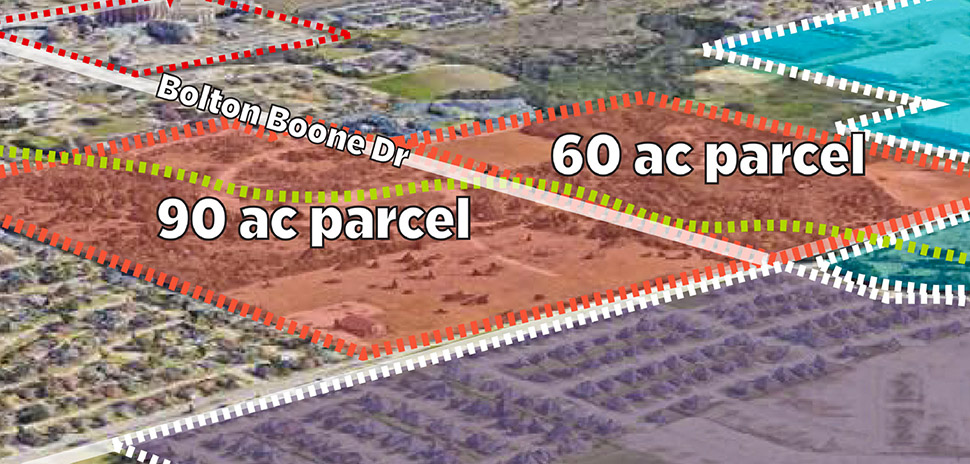
The southern half of Dallas County is home to just over 1.05 million residents. That’s about 40% of the total number of people who call Dallas County home—and roughly 200,000 more than the entire population of San Francisco. Coupled with the fact that Dallas-Fort Worth is emerging as a top life science market, as documented in a 2023 CBRE report, you can see why the DeSoto Development Corp. is including an 80-acre Life Sciences Innovation Core among its major projects. “In terms of economic development, research shows that it’s more effective when it happens regionally,” says Matt Carlson, DDC's chief…