![Manufacturing Institute President Carolyn Lee delivers the annual State of the Manufacturing Workforce Address at NTT DATA's North American headquarters in Plano on Feb. 25, 2026. [Screenshot/NAM YouTube]](https://s24806.pcdn.co/wp-content/uploads/2026/02/Carolyn-Lee.png)
The National Association of Manufacturers made North Texas a centerpiece of its 2026 national tour this week, and the message was clear: the future of American manufacturing depends less on machines than on the people who run them.
“To put it bluntly, workforce is not a side issue. It is the strategy,” said Carolyn Lee, president of the Manufacturing Institute, describing it as the NAM’s workforce development affiliate. “We don’t just need people. We need talent. And that means our workforce needs the skills to succeed.”
NAM President and CEO Jay Timmons echoed the point. “At the very top is always the workforce and making sure that we have the people that we need to lead us forward,” he said.
Lee delivered the Manufacturing Institute’s annual State of the Manufacturing Workforce Address on Wednesday at NTT DATA’s North American headquarters in Plano. A panel discussion followed, featuring Lee, Timmons, NTT DATA Products Industries Global Leader Prasoon Saxena, and Celanese Senior Vice President and Chief Information Officer Sameer Purao.
Taken together, the address and panel made the case that the industry is at an inflection point. “All of this is happening faster than necessarily I would have banked on a couple of years ago and probably six months ago,” Lee said during the panel.
Manufacturers have integrated robotics, machine learning, and data analytics on shop floors for decades, but the rapid rise of AI is connecting those systems in ways that are transforming how work gets done. Even as the sector faces a looming workforce shortfall and a generational shift in how young Americans think about careers.
“A shifting industry calls for more effort to train, upskill, and keep our people,” Timmons said.
He acknowledged that “leaders in Washington truly need to invest in our policies to build that stronger workforce,” but quickly pivoted. “We’re the ones that need to lead the way,” he said.
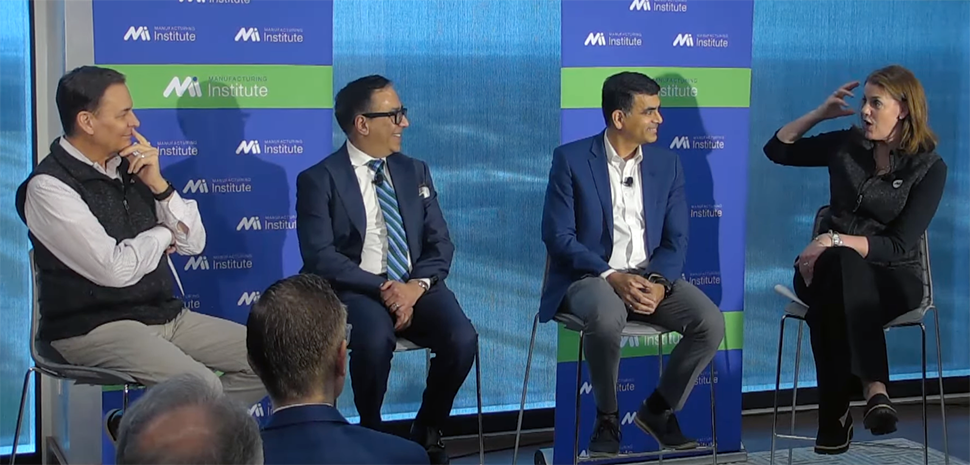
From left, NAM President and CEO Jay Timmons, NTT DATA’s Prasoon Saxena, Celanese’s Sameer Purao and Manufacturing Institute President Carolyn Lee during a panel discussion on AI and the manufacturing workforce at NTT DATA’s North American headquarters in Plano on Feb. 25, 2026. [Screenshot/NAM YouTube]
The numbers behind the urgency
Lee framed the workforce challenge as structural—not a crisis, but a gap that demands action while conditions are favorable.
She presented projections showing the scale of the problem. The manufacturing sector could face nearly 1.9 million unfilled positions by 2033, according to research by the Manufacturing Institute and Deloitte.
More than half of manufacturers are already deploying artificial intelligence, and 80% say it will be essential to their growth by 2030, according to the Manufacturing Leadership Council, which Lee described as “the digital transformation division of the National Association of Manufacturers.”
In Texas alone, nearly 1 million manufacturing workers drive a sector representing between 11% and 13% of the state’s economic output, according to the NAM.
The other half of her data suggested the momentum is real. A Harris poll found that 50% of Gen Z-ers are interested in blue-collar careers—”more than twice as high as Americans overall,” Lee said. Americans’ skepticism about the value of a four-year degree has grown sharply: in 2013, 40% said it wasn’t worth the cost. By 2023, that figure was 56%, she said.
“So as more young people seek out skilled pathways, we must seize the opportunity to ensure they see manufacturing as a sector in which they apply those skills for a durable career,” Lee said.
AI on the shop floor: ‘It elevates them’
Lee took on the fear around artificial intelligence head-on—both in her address and in the panel that followed.
“People often ask me whether AI is coming for manufacturing jobs,” she said. “Here’s what I believe: AI won’t take your job. But jobs will go to people who know how to use AI.”
She pointed to the technology’s practical impact: AI-powered systems are making workplaces safer, supply chains stronger and operations more efficient. “Predictive analytics reduce downtime. Smart simulations accelerate product design,” she said. “When applied the right way, AI doesn’t replace workers—it elevates them, pairing human judgment with machine precision to make jobs more skilled, more resilient and more rewarding.”
To illustrate the point, Lee shared what a manufacturing leader told her about how AI is changing an operator’s job. The operator who once stood at a single machine turning dials can now manage a fleet of machines—assessing inputs, tracking the supply chain, monitoring materials across multiple systems.
“You’re elevating that individual operator who needs to now have horizontal awareness across multiple aspects and manage the system instead of being the individual player,” she said during the panel. Her follow-up was blunt: “Is anyone ready for that?”
She also recounted a conversation with a 65-year-old manufacturing worker who has spent 40 years in the industry. Rather than heading for retirement, the man told her he wanted to stay. “The job is safer. It’s even more interesting. I’ve learned more in the last five years than I’ve learned in my previous 35 years—and I’m excited for what’s to come,” Lee said, quoting the worker.
‘We’ve all watched too much TV’
During the panel, Lee acknowledged that the pace of change is fueling anxiety—and said part of the problem is perception.
“I think that’s actually what drives the fear,” she said. “We’ve all watched too much TV, and so therefore the only image out there is Terminator or I Robot.” The antidote, she said, is connection—bringing workers closer to the technology, not shielding them from it—and skills training that lowers what she called “the fear factor.”
“The answers to this moment must come from us—from manufacturers,” Lee said in her address.
She recalled seeing a sign on the wall of a factory she visited earlier in the tour week: “We build machines to help humans, not to replace humans. The machines help humans do more.”
“That didn’t have a sticker on it that they just hung it up this week,” Lee said. “That has always been the case. It’s just more prevalent.”
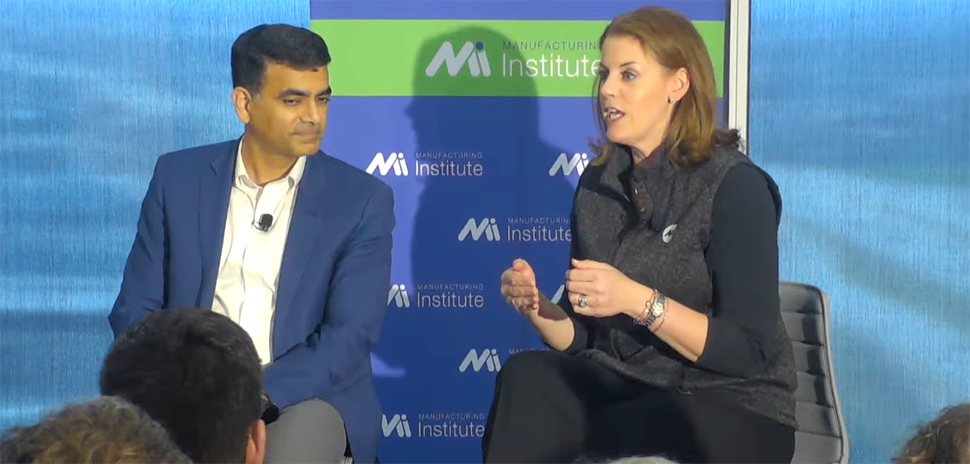
Celanese Chief Information Officer Sameer Purao (left) and Manufacturing Institute President Carolyn Lee discuss AI and the manufacturing workforce during a panel at NTT DATA’s North American headquarters in Plano on Feb. 25, 2026. [Screenshot/NAM YouTube]
On the panel, Purao drew a distinction between jobs and roles. “It’s definitely going to create jobs,” he said, “but it’s going to kill the roles. The roles are going to be very, very different.”
He pointed to operator safety rounds and inspections as an example—tasks now handled by AI analytics, with the workers who once did them being retrained to interpret the data instead. “Your roles are going to change, and we are going to hold hands and train you and walk you through the newer roles,” he said.
For employers and boards, there is no choice. There is no choice, Purao said. “It’s a survival.”
“Your kids or your grandkids bond with these gadgets … They’re not going to be able to work in the manufacturing environment that is not digitalized,” he said.
Saxena described how AI is collapsing what used to be four or five separate roles—mechanic, shop floor worker, IT technician, technologist—into a cross-skilled position where one person needs to understand the data, the equipment, and the systems together.
Saxena thinks “it’s going to create more jobs—and also new companies will emerge because of that.”
Employers at the center
Lee noted that the workforce solution has to be employer-led.
“No one understands the skills manufacturing requires better than employers themselves,” she said in her address. “If workforce is the strategy, then employers must help design it, lead it, and sustain it.”
She pointed to the FAME apprenticeship program—the Federation for Advanced Manufacturing Education—as a model. Since the Manufacturing Institute took over stewardship of FAME from Toyota six years ago, the program has more than doubled in size, Lee said. It now includes nearly 500 companies across 17 states with an 85% job placement rate with sponsoring employers.
The MI’s investment case is strong. McKinsey & Company assessed the institute’s programs last year and found that “for every dollar invested in the MI, it generates a fivefold return in total economic impact,” Lee said.
Training matters for retention, too. An MI survey found that 69% of manufacturing employees under 25 said training was a motivating factor in their decision to stay with their employer.
‘When manufacturing leads, America works’
Timmons, who also chairs the Manufacturing Institute’s board, framed the moment as an inflection point during the panel.
“This is our moment,” he said. “We shape our own destinies. We drive our own talent, we build our own workforce, and we need to master the right approach to do exactly that.”
Lee closed her address with a sweep through manufacturing’s historical role in the American economy—”from the factories that powered the Industrial Revolution to the assembly lines that mobilized an arsenal of democracy, from the boom that built the middle class to the advanced production that created the modern economy”—and brought it back to the present.
“When manufacturing leads, America works,” she said. “So, let’s lead—together.”
The 2026 NAM State of Manufacturing Tour, which earlier visited New York, Ohio, Pennsylvania, North Carolina, and Wisconsin, continues to Houston and concludes Friday in Phoenix. The full address and panel discussion are available on YouTube.
Don’t miss what’s next. Subscribe to Dallas Innovates.
Track Dallas-Fort Worth’s business and innovation landscape with our curated news in your inbox Tuesday-Thursday.
R E A D N E X T
-
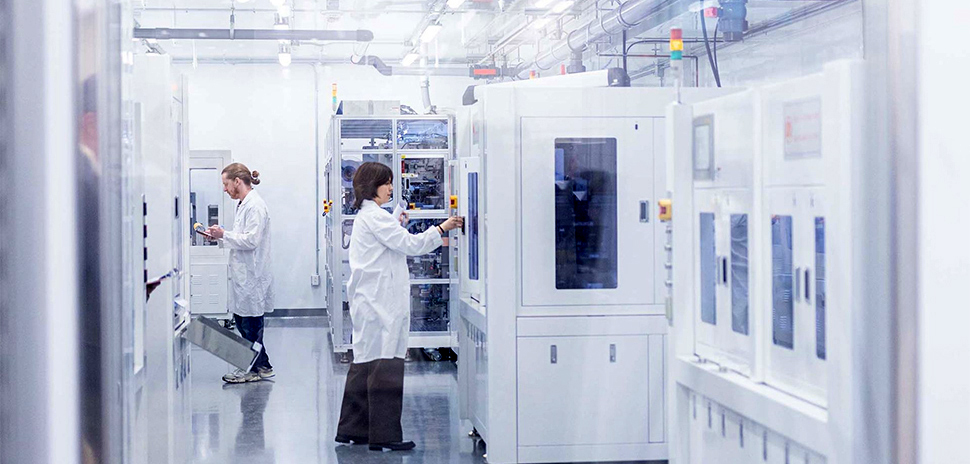
Backed by the Department of Defense and $200 million in private capital, the new facility helps companies prototype and scale battery technologies for both commercial use and national defense. The launch comes at a time when supply chain independence is a growing priority. Government and industry leaders recently got a first look.
-
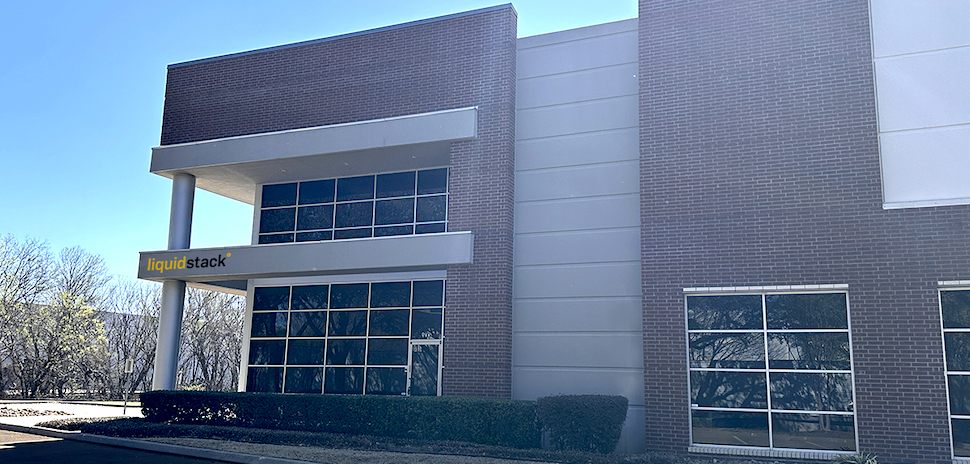
A global leader in liquid cooling for data centers, LiquidStack said its new 17,000-square-foot facility will increase its production capacity, while serving as a new R&D and service training facility.
-
Austin-based Flex said its new facility in East Dallas "significantly boosts production capacity and efficiency" for its grid-to-chip data center power infrastructure solutions, including power pods, power distribution units, and low-voltage switchgear.
-

The new federal Alzheimer's hub joins an elite network of 37 centers nationwide. Scientists from UT Southwestern, UT Arlington, and UT Dallas will decode dementia by exploring hypertension's role, analyzing voice patterns with AI, and creating virtual patient models.
-
Broadcom executive Vikas Sinha and his wife, Anuradha, have invested more than $5 million in UNT’s data science program, aiming to fuel opportunity in a field “at the heart of the job market.”