Geophysicists at SMU have developed a sensor small enough to slip into a pocket—and produced it at a scale that is changing how scientists study the atmosphere.
The Sapphire microbarometer measures low-frequency sound waves that travel through the air below the range of human hearing. Known as infrasound, these waves can move across long distances and carry information about both natural phenomena and human activity.
Portable microbarometers have existed before, but the Sapphire is the first that can be produced in large numbers, significantly expanding what researchers can measure in the field, SMU said.
Detecting ocean waves from a Dallas lab
From his lab in Dallas, SMU researcher Stephen Arrowsmith can use the Sapphire sensor to detect ocean waves striking the Texas coast from nearly 500 miles away. He said new measurement tools like this often become the starting point for larger advances in Earth science.
“History shows that breakthroughs in geophysics often start with new ways to measure the Earth,” Arrowsmith said. “These sensors may unlock discoveries we can’t yet imagine—just as past innovations transformed our understanding of the planet.”
Traditional infrasound instruments have typically been large, costly, and difficult to deploy widely. SMU research professor Chris Hayward addressed that challenge by scaling the Sapphire microbarometer into hundreds of low-cost, battery-powered devices, each roughly the size of a juice box.
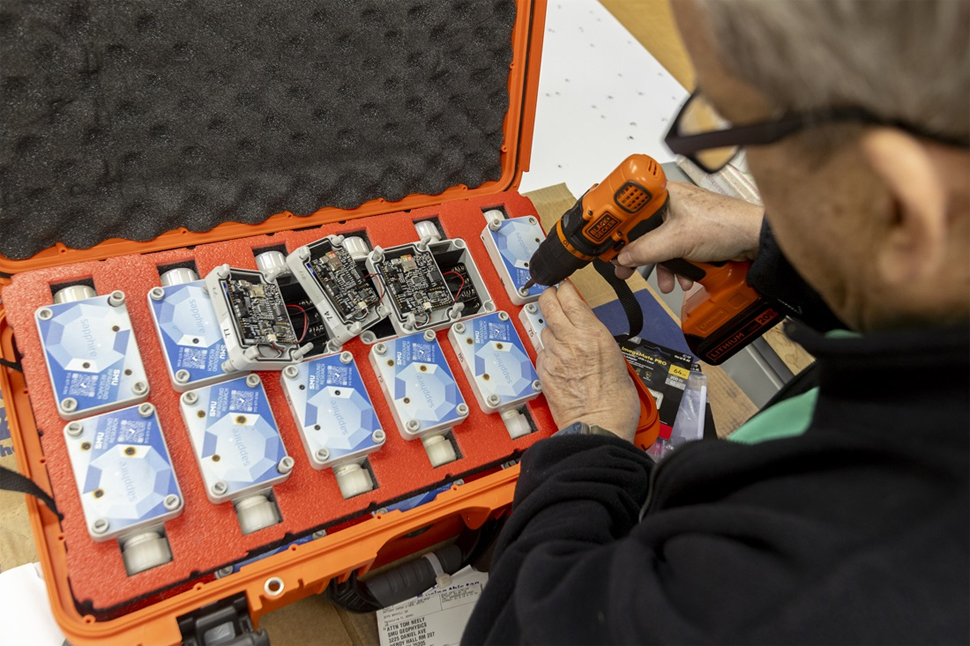
SMU research professor Chris Hayward scaled the Sapphire microbarometer into hundreds of portable, battery-powered sensors designed for large-scale infrasound research. [Photo: SMU]
The sensors have already been tested at scale. SMU researchers recently deployed 250 Sapphire units in Norway as part of a controlled experiment on a custom fiber-optic network to examine how acoustic waves interact with buried cables. The project advanced understanding of Distributed Acoustic Sensing, a technique that uses fiber-optic networks as virtual seismic sensors.
The team also uses the pocket-sized sensors in smaller field tests around the world. They’ve measured infrasound from the nightly firing of an 1800s-era cannon in Vancouver’s Stanley Park and captured the low-frequency signature of Niagara Falls. Researchers often bring a Sapphire unit with them when they travel, ready to record new infrasound events whenever opportunities arise, SMU said.
Infrasound offers a window into both natural and human-made activity. According to Arrowsmith, the signals can reveal earthquakes, volcanic eruptions, explosions, and urban noise, as well as atmospheric conditions such as temperature and wind patterns that support weather forecasting.
SMU has long played a role in global seismic and infrasound monitoring. For more than three decades, the university has operated monitoring stations for the U.S. government as part of the International Monitoring System, which tracks nuclear detonations banned under the Comprehensive Nuclear Test Ban Treaty. SMU maintains monitoring sites in West Texas, Nevada, and on the Korean Peninsula.
A seismo-acoustic team led by Arrowsmith and Hayward, together with researchers Brian Stump and Paul Golden, analyzes acoustic and seismic waves to determine whether they come from natural events or human activity. Working with monitoring arrays in Texas and Nevada, the group studies signals from earthquakes, volcanic eruptions, explosions, and mining operations.
Arrowsmith said the devices are broadening what researchers can measure in environments around the world. “We keep coming up with new cool experiments we can conduct with the Sapphire microbarometer,” he said.
Don’t miss what’s next. Subscribe to Dallas Innovates.
Track Dallas-Fort Worth’s business and innovation landscape with our curated news in your inbox Tuesday-Thursday.
R E A D N E X T
-

The southern half of Dallas County is home to just over 1.05 million residents. That’s about 40% of the total number of people who call Dallas County home—and roughly 200,000 more than the entire population of San Francisco. Coupled with the fact that Dallas-Fort Worth is emerging as a top life science market, as documented in a 2023 CBRE report, you can see why the DeSoto Development Corp. is including an 80-acre Life Sciences Innovation Core among its major projects. “In terms of economic development, research shows that it’s more effective when it happens regionally,” says Matt Carlson, DDC's chief…
-

The investment will establish a new Energy Science, Innovation, and Enterprise program and boost SMU’s reach in recruiting top students and faculty, the university said. One key goal: connecting talent directly with the companies and industries shaping the future.
-

As drones, robots, and AI-powered systems reshape industries, virtual test beds could fill a cybersecurity gap. Researchers at SMU's Darwin Deason Institute aim to uncover hidden vulnerabilities in next-generation systems—before bad actors do.
-

Bowles will advise the Lab’s leadership team and students on fund strategy, investment process, and entrepreneurial execution, and will bring "a practical investor’s perspective" to the lab’s mission of supporting ventures that create measurable social impact.
-
Broadcom executive Vikas Sinha and his wife, Anuradha, have invested more than $5 million in UNT’s data science program, aiming to fuel opportunity in a field “at the heart of the job market.”